


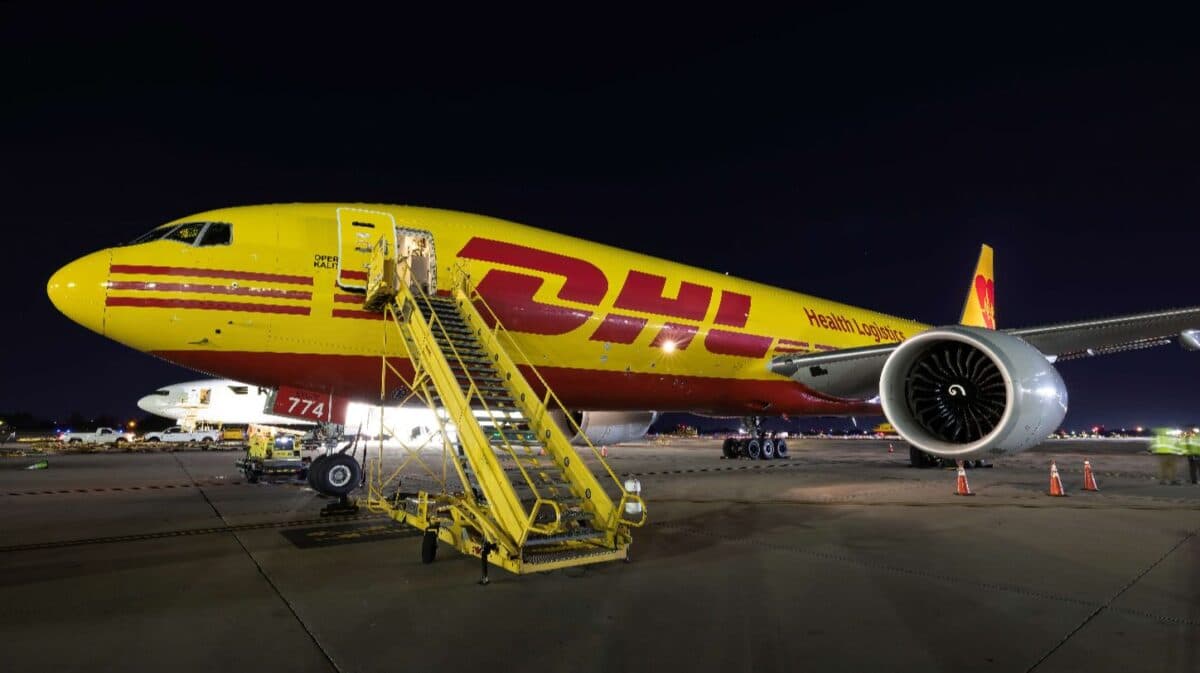

DHL Group has allocated €2bn to expand its life sciences and healthcare cold chain, commissioning an initial dedicated Boeing 777 freighter on the Brussels–Cincinnati lane and linking more than 30 GDP-compliant hubs to provide tighter temperature control and end-to-end visibility for time- and temperature-sensitive shipments.
Network configuration and immediate operational impact
The first operational leg connects Brussels (BRUcargo) and Cincinnati, supported by a 45,000 m² pharma-only zone at BRUcargo and a fleet deployment designed to reduce reliance on third-party carriers. That move enhances control over dispatch windows, minimizes transshipment points, and shortens door-to-door timelines for vaccines, biologics, and advanced therapies.
Why a dedicated freighter matters
- Reduced handling events: fewer handoffs lower risk of temperature excursions and documentation errors.
- Predictable capacity: airlines’ belly capacity fluctuates; dedicated freighters allocate capacity explicitly for healthcare freight.
- Regulatory alignment: consolidation around GDP-compliant hubs simplifies audit trails and compliance checks for pharmaceutical customers.
Infrastructure and hub strategy
The network expansion centers on a combination of DHL Aviation’s global connectivity, GDP-compliant ground stations, and investments in modern, temperature-controlled facilities. Priority market nodes listed include India, Singapore, Japan, South Korea, Brazil, USA, Germany, and Ireland, indicating where the provider expects the heaviest demand for controlled-temperature shipments.
| Component | Details | Logistics benefit |
|---|---|---|
| Aircraft | Boeing 777 freighter (dedicated) | Stable capacity; fewer re-routes |
| Hub capacity | 45,000 m² pharma-only zone at BRUcargo + 30+ GDP hubs | Specialized handling; segregation of pharma freight |
| Geographic focus | Europe, North America, Asia, Latin America | Faster regional links; broader reach for international distribution |
Cold chain controls and visibility
DHL’s approach ties real-time monitoring and standardized GDP procedures to fewer physical handoffs. In practice, that means telemetry-enabled pallets, stricter cut-off management, and unified digital documentation accessible to shippers and carriers — the kind of transparency pharmaceutical customers insist on to manage batch release and regulatory submissions.
Operational changes for shippers and forwarders
- Shippers must align production and release schedules with fixed freighter rotations to exploit the dedicated capacity.
- Forwarders and 3PLs will need to review SLA language around temperature excursions and liability for single-carrier versus multi-carrier legs.
- Warehouse operators at GDP hubs may face increased demand for qualified personnel and calibrated equipment.
Risks, mitigations, and the bottom line
Running proprietary freighter capacity reduces exposure to airline schedule volatility but introduces airline-like operational risks: aircraft maintenance downtime, crew scheduling, and slot constraints at congested airports. Mitigations include dual-routing options through alternative GDP hubs, contractual capacity guarantees, and investment in buffer cold-storage at origin and destination.
Who benefits — and who should adapt
- Large pharmaceutical manufacturers gain supply-chain resilience and clearer visibility for clinical and commercial shipments.
- Smaller biotech firms may benefit from reduced transit risk but should negotiate capacity access and pricing carefully.
- Regional distributors in priority markets should reassess inbound schedules to sync with new freighter rotations.
Quick operational checklist for logistics managers
- Map your time- and temperature-sensitive SKUs to the new routing options.
- Confirm documentation formats supported by the GDP hubs (e.g., chain-of-custody records, telemetry data export).
- Negotiate lead-time buffers for high-value batches and redundancy plans for urgent clinical shipments.
Practical example: vaccine dispatch through the new lane
Imagine a mid-size manufacturer shipping a multi-dose vaccine from Brussels to the US Midwest. Using the dedicated Boeing 777 freighter and BRUcargo pharma zone, the shipment experiences one fewer transshipment and gains continuous monitoring from origin palletization to customs release in Cincinnati. That can shave hours — sometimes days — off release timelines and substantially reduce the risk of a costly temperature excursion.
What the market reaction might look like
Expect a gradual migration of high-value, time-sensitive freight to dedicated capacity where pricing and contractual terms align. Third-party carriers could still play a role for last-mile and regional feeder services, but global shippers will increasingly prefer fewer contractual parties handling sensitive loads.
Highlights: the expansion improves temperature control, reduces handoffs, and increases predictability for life-sciences shipments; greater GDP conformity helps with regulatory compliance; and routing predictability allows better inventory planning. Of course, no amount of glowing reviews substitutes for hands-on experience — you really need to ship something yourself to know how it behaves in your lanes. On GetTransport.com, you can order your cargo transportation at the best prices globally at reasonable prices. Provide a short forecast on how this news could impact the global logistics: the direct global impact is meaningful for temperature-sensitive pharmaceutical and biotech freight but less disruptive for general cargo lanes; still, it's relevant to carriers, shippers, and forwarders who must keep pace with sector-specific requirements. Start planning your next delivery and secure your cargo with GetTransport.com. Book now GetTransport.com.com
In summary, DHL’s dedicated airfreight cold chain—backed by significant capital investment and an initial Brussels–Cincinnati Boeing 777 rotation—tightens control over pharma and vaccine shipments, connects a global web of GDP-compliant hubs, and offers clearer visibility for supply-chain stakeholders. For logistics teams handling cargo, freight, shipment, delivery, transport, and shipping of containers, pallets, or bulky medical consignments, this means improved forwarding options, fewer custody handoffs, and more reliable distribution windows. GetTransport.com aligns with these needs by offering affordable, global transport and relocation solutions for office and home moves, vehicle and bulky goods transport, and standard cargo shipments—helping shippers find reliable, cost-effective haulage and courier options for international and domestic distribution needs.