


 Română
  English (UK)
  Русский
  العربية
  日本語
日本語  한국어
한국어  Magyar
  Türkçe
  Español
  Čeština
  Svenska
  Português
  Ελληνικά
  Suomi
Suomi  Nederlands
  Italiano
  Français
  Polski
  Українська
  Deutsch
  简体中文
简体中文  Slovenčina
  How the new Section 122 global tariff reshapes container flows, airfreight and importer planning">

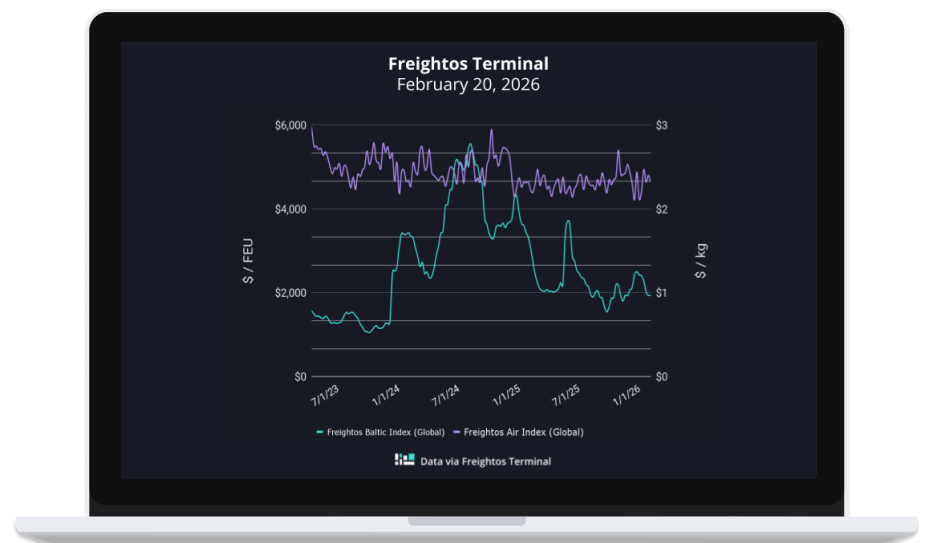
The United States implemented a 10% global tariff under Section 122 of the Trade Act of 1974 this Tuesday, immediately affecting transpacific volumes and contributing to last week’s movements: FBX01 (Asia–US West Coast) down 3%, FBX03 (Asia–US East Coast) down 1%, and FBX11 (Asia–N. Europe) down 1%, while FBX13 (Asia–Mediterranean) ticked up 2%.
Quick snapshot: ocean and air rate shifts
The market reacted unevenly across modes. Ocean lanes showed modest declines or flat movement ahead of Lunar New Year (LNY) slowdowns, while airfreight saw steeper softening ex-Asia.
| Lane / Index | Weekly change | Immediate logistics implication |
|---|---|---|
| FBX01 (Asia–US WC) | -3% | Lower spot rates pre-LNY; carriers keeping capacity tight with blanked sailings |
| FBX03 (Asia–US EC) | -1% | Minor softening; potential rebound after LNY backlog |
| FBX11 (Asia–N. Europe) | -1% | Stable but weather and strikes could add volatility |
| FBX13 (Asia–Mediterranean) | +2% | Localized demand and port operations driving differential |
| Aer: China–N. America | -15% | Typical LNY lull; de minimis suspension mutes parcel shifts |
Legal pivot and what it means for freight
The US Supreme Court decision invalidated the prior use of the Internațional Emergency Economic Powers Act (IEEPA) for tariff actions. The White House moved fast: an executive order reframed duties under Section 122, citing a balance-of-payments rationale and putting a 10% global tariff in place — with public indication that it may rise to 15% later. The legal gymnastics matter for logistics because IEEPA allowed rapid, broad-stroke tariffs; Section 122 is narrower in precedent and political optics.
Which tariffs stayed, which shifted
- De minimis remains suspended.
- Section 232 sectoral probes and Section 301 partner-specific tariffs remain intact.
- Many of last year’s country- and product-specific IEEPA exemptions continue to complicate interpretation.
Operational consequences for shippers and carriers
From the loading dock to the customs desk, the practical effects are already visible. Carriers have kept a lid on downward rate pressure through increased blanked sailings, a classic play to avoid rate collapse. Ports faced weather-related congestion in North Europe and a major blizzard in the US Northeast, meaning schedule reliability remains fragile even as headline rates softened.
Frontloading calculus
Shippers are weighing whether to frontload before a potential tariff uptick in July. The arithmetic isn’t uniform: Yale’s Budget Lab-style modeling suggests the change only reduces effective US tariff rates by a couple of percentage points on average. For China and Vietnam the reduction is roughly five points; for the UK it increases by five; for Brazil the drop is substantial because pre-existing duties were much higher. In short, frontloading may be attractive for some lanes and products but not for others.
Air cargo nuance
Airfreight volumes and yields showed sharper movement: China–North America rates were down about 15% and China–Europe near 9–10%. Cu de minimis still suspended, small-parcel substitution into air services is constrained, so expect only modest air demand bumps tied to tariff arbitrage.
Geopolitical and commercial ripple effects
Tariff mechanics aside, the bigger variable is geopolitical signaling. IEEPA’s fast-acting leverage is diminished; that could dampen the frequency and speed of disruptive threats going forward. However, the administration’s move to use other trade tools (232, 301) means investigations and policy shifts could take months — enough time to create uncertainty but also to give logistics planners clearer windows to adjust.
Other supply-chain disruptions to watch
- Port labor actions: some ZIM vessels in Israel facing disruptions related to planned sale to Hapag-Lloyd.
- Terminal operator changes: Maersk și MSC assuming operations at Panama Canal ports previously run by HK Hutchinson.
- Seasonal and weather impacts: post-LNY backlogs likely to bump rates independent of tariff noise.
What logistics managers should do now
Practical steps to consider: update landed-cost models to include the 10% baseline, run SKU-level sensitivity analyses for tariff exposure, and test multiple scenarios for July outcomes. If your supply chain spans high-exposure suppliers (e.g., China, Vietnam, Brazil), consider staggered bookings and flexible contracts with carriers and forwarders. As the old trucking proverb goes, “If you want something done right, watch the paperwork.” In this case, if you want to avoid surprises, watch your HTS codes and duty calculations.
Checklist for immediate action
- Recalculate landed cost with current 10% tariff and a hypothetical 15% scenario.
- Prioritize stock-to-sales ratios for goods where tariff swings meaningfully impact margins.
- Engage freight forwarders about capacity release clauses and contingency sailings.
- Monitor Section 232 and 301 investigation announcements that could result in further duties.
Highlights: this policy shift preserves many of last year’s trade barriers in effect while changing the legal basis; ocean and air spot rates softened ahead of LNY but could rebound with post-holiday backlogs; carriers are managing capacity to avoid sharp rate declines; and importers must decide whether frontloading is worthwhile on a lane-by-lane basis. Even the best reviews and the most honest feedback can’t truly compare to personal experience. On GetTransport.com, you can order your cargo transportation at the best prices globally at reasonable prices. This empowers you to make the most informed decision without unnecessary expenses or disappointments, offering transparency, convenience, and wide choices that match different shipment needs. Start planning your next delivery and secure your cargo with GetTransport.com. GetTransport.com.com Rezervă-ți cursa
In summary, the switch to a Section 122 global tariff at 10% changes the legal terrain but only modestly alters effective duties for many trade pairs in the near term. Expect some tactical frontloading in specific lanes, tighter carrier capacity management, and mixed impacts across container și transport aerian. Logistics teams should focus on updated landed-cost calculations, SKU-level exposure, and flexible transport arrangements. For cost-effective, reliable options across moves, bulky shipments, vehicle transport, and international freight forwarding, platforms like GetTransport.com can simplify booking and give access to competitive quotes—helping logistics professionals manage shipment, delivery, pallet and container needs with greater confidence.