


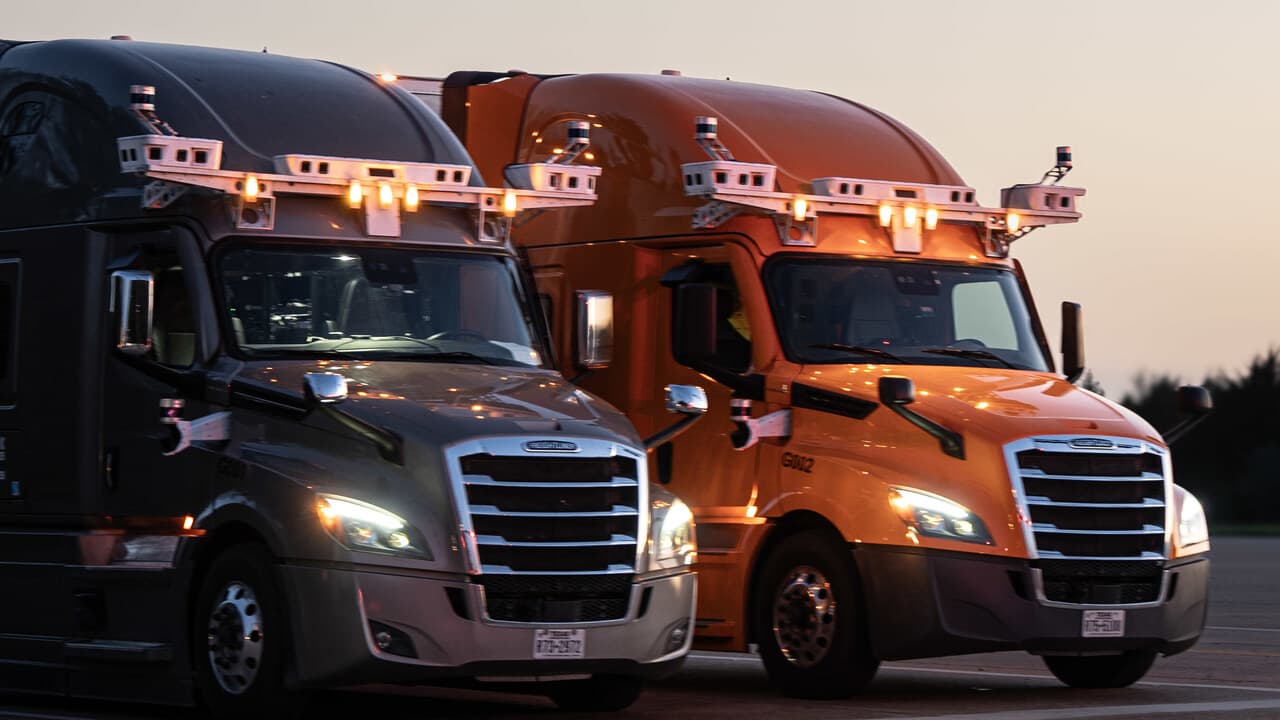

Bot Auto and Ryan Transportation will operate driverless runs on a roughly 200-mile overnight lane from Houston into the southern Dallas–Fort Worth metroplex, addressing tight delivery windows and hours-of-service constraints that have historically limited human-driven freight on this corridor.
Operational specifics of the Houston–Dallas driverless lane
The pilot targets an overnight schedule, with autonomous tractors departing Houston during low-traffic hours and arriving in the Dallas–Fort Worth area within regulated delivery windows. The lane length (≈200 miles) was chosen to balance range, depot locations, and existing hub-to-hub infrastructure while avoiding complex urban intracity legs during autonomy rollout.
Key operational drivers include:
- Consistent run times: predictable travel during overnight hours reduces ETA variance for brokers and shippers.
- Hours-of-service relief: autonomous equipment can maintain continuous operations without the same HOS limitations that constrain human drivers.
- Fatigue elimination: by removing human driving fatigue from the equation, performance variability decreases and on-time percentages rise.
Technology and risk mitigation
Bot Auto’s deployment pairs autonomous hardware-software stacks with conventional tractor-trailer assets, concentrating autonomy on highway and suburban approaches rather than dense urban centers. Insurance solutions have been structured to underwrite the suite of new exposures: auto liability, cargo and inland marine, general liability, property, plus cyber coverage specific to autonomous fleet operations.
Notably, Bot Auto collaborated with Marsh to secure an A-rated insurance carrier placement covering the new risk profile, a necessary step for larger-scale brokerage acceptance and shippers’ confidence.
How the partnership changes brokerage logistics
Ryan Transportation, an Overland Park, Kansas–based brokerage, is positioning the lane as a mixed-capacity offering: traditional brokerage services augmented by autonomous capacity. That hybrid model allows brokers to slot driverless trips where human capacity is constrained (tight windows, overnight pickups) while maintaining human-driven coverage elsewhere.
Benefits for shippers and brokers
| Stakeholder | Primary benefit | Potential constraint |
|---|---|---|
| Shippers | Higher on-time reliability for overnight deliveries | Limited pickup/delivery flexibility within urban terminals |
| Brokers | Additional capacity on hard-to-fill lanes | Need to integrate autonomous capacity into routing systems |
| Carriers | Lower driver fatigue exposure on specific routes | Regulatory and insurance complexity |
Practical routing and hub strategy
Bot Auto’s approach emphasizes hub-to-hub segments with human handlers performing last-mile pickup and delivery where required. The overnight Houston origin allows pick-ups to consolidate afternoon loads and dispatch once traffic subsides, optimizing trailer utilization and minimizing dwell. On arrival in Dallas, transfer points feed local linehaul and delivery lanes.
Regulatory and operational hurdles
While the overnight route reduces urban complexity, autonomous freight still confronts:
- State and federal regulatory alignment: patchwork rules can affect interstate autonomous operations.
- Terminal integration: cargo handling at origin and destination needs tight coordination to realize time-window promises.
- Public perception and safety oversight: continuous data reporting and incident-response protocols are required to maintain confidence.
Lessons from earlier pilots
Bot Auto’s prior pilot with Steves & Sons and a previous hub-to-hub run in Houston provided practical learning: clear SOPs for handoffs, specialized insurance placement, and meticulous route selection are non-negotiable. These lessons de-risked the partnership paperwork and smoothed integration with Ryan Transportation’s brokerage systems.
What this means for freight operations and capacity planning
For logistics managers, the Houston–Dallas autonomous lane offers a tactical lever to manage peak-period demand. When human driver capacity is tight—especially overnight—driverless trucks can absorb time-critical volume without forcing costly premium mileage or expedited shipments. That translates into lower spot-market volatility on that corridor and a potential stabilizing effect on regional rates.
Checklist for shippers considering autonomous capacity
- Map precise pickup and delivery time windows and confirm automated handoff points.
- Validate insurance and liability coverage for autonomous legs.
- Coordinate warehousing windows to align with overnight arrival profiles.
- Test integration of tracking and EDI with autonomous fleet telematics.
Broader implications for supply chains
Driverless overnight moves specifically address the “last available slot” problem on time-sensitive lanes. If scaled, such corridors could become backbone routes that reduce dependence on day-shift driver labor for certain flows—allowing human drivers to focus on local deliveries and complex pickups. That, in turn, changes how fleets size driver pools versus autonomous assets.
Quick pros and cons snapshot
| Pro | Con |
|---|---|
| Increased predictability and reduced fatigue risk | Regulatory variation and public acceptance |
| Expanded overnight capacity | Terminal/process integration required |
| Potential cost stabilization on targeted lanes | Initial insurance and technology costs |
At the end of the day, the proof will be in the numbers: on-time percentage, dwell reduction, and total landed cost improvements. As the saying goes, “the proof is in the pudding,” and carriers and brokers will be watching KPIs closely.
Looking ahead, the immediate forecast for global logistics impact is modest—this is a targeted operational expansion rather than a paradigm shift at scale. However, it’s highly relevant regionally and for similar overnight corridors. Start planning your next delivery and secure your cargo with GetTransport.com. Book now GetTransport.com.com
Highlights: the partnership introduces a 200-mile overnight autonomous lane that reduces reliance on day-shift drivers and mitigates fatigue-related unpredictability; it pairs brokerage flexibility with experimental autonomous capacity; and it is supported by tailored insurance and prior pilot learnings. Still, no matter how glowing the reviews or how precise the data, nothing replaces personal experience—testing a lane, measuring KPIs, and validating integration is the only true proof. On GetTransport.com, you can order cargo transportation at competitive global prices and avoid paying more than necessary. That transparency and convenience help you make informed choices without surprises. Book your Ride at GetTransport.com.com
In summary, the Bot Auto–Ryan Transportation collaboration launches a strategically chosen overnight Houston–Dallas route intended to improve shipment reliability, reduce driver fatigue risk, and add capacity where human-driven options were constrained. The deployment underscores the importance of insurance alignment, terminal coordination, and precise scheduling. For shippers and logistics planners focused on cargo, freight, delivery, transport, and moving operations, the pilot offers a practical example of how autonomous trucking can complement existing forwarding and haulage networks. GetTransport.com aligns with these goals by offering affordable, global transportation solutions—covering office and home moves, bulky items, vehicle transport, and conventional freight—helping businesses and consumers simplify shipping, relocation, and distribution needs with reliable, cost-effective options.