


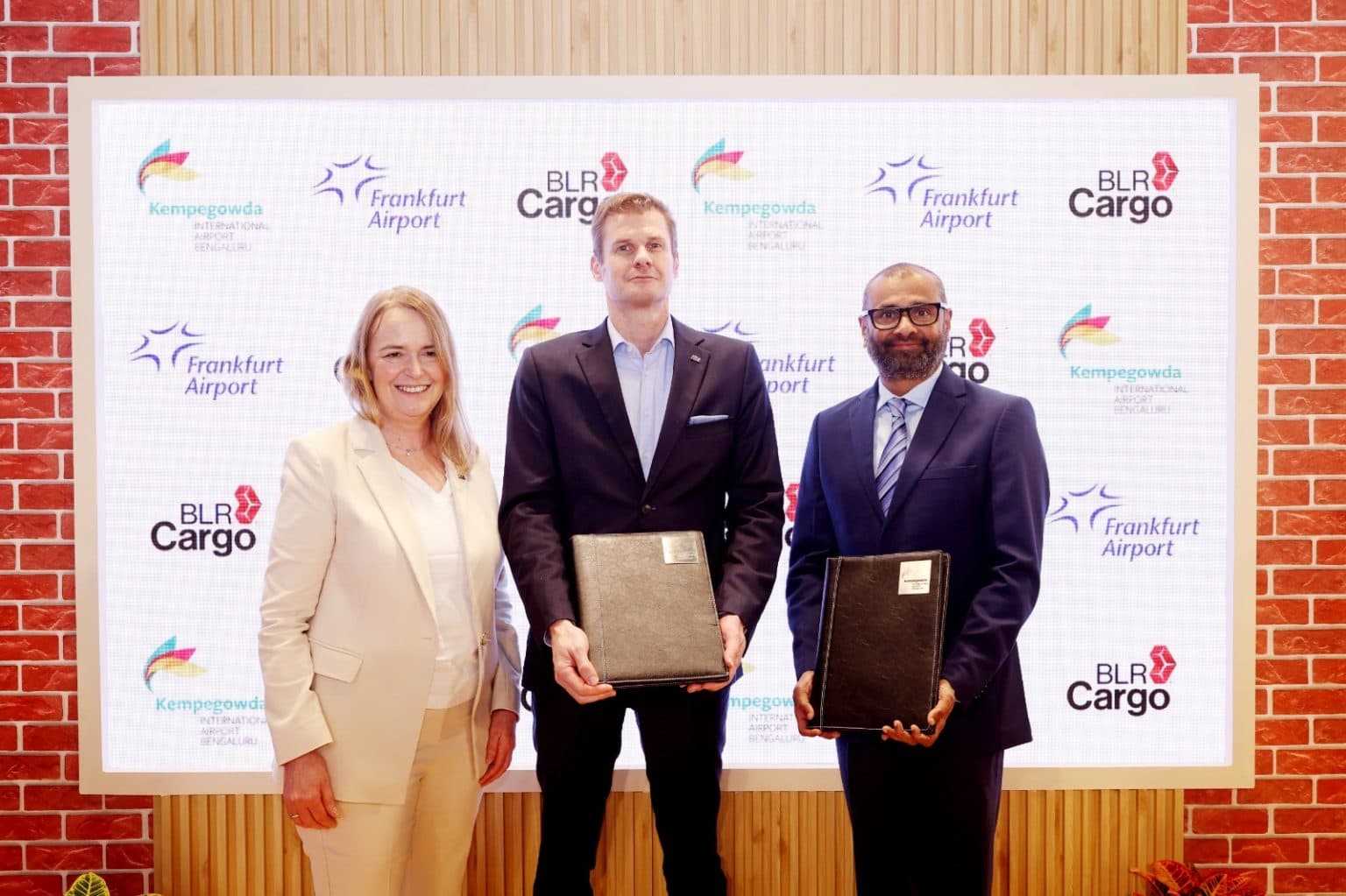

On 25 February 2026, Kempegowda International Airport Bengaluru (BLR), operated by Bangalore International Airport Limited (BIAL), and Frankfurt Airport (FRA) signed a Memorandum of Understanding during Air Cargo India to establish a structured, data-led framework aimed at improving cargo connectivity between South India and Europe.
What the MoU concretely commits to
The agreement sets out joint actions around trade lane analytics, digital corridor development, pharma integrity standards and knowledge exchange. The immediate operational goals are to increase visibility, reduce dwell times and deliver more predictable service levels for airlines, freight forwarders and shippers moving high-value or time-sensitive consignments.
Key technical and operational measures
- Trade lane analytics: shared KPIs and traffic modelling to identify bottlenecks and capacity gaps.
- Digital corridors: aligned EDI standards and real-time data exchange for flight, ground-handling and customs events.
- Pharma integrity: harmonised temperature-monitoring protocols and expedited handling lanes for cold-chain shipments.
- Knowledge exchange: training programs and joint workshops for handlers, airlines and forwarders.
Why BLR–FRA matters for shippers
BLR serves one of India’s fastest-growing manufacturing and export regions, while FRA ranks among Europe’s most connected cargo hubs. By aligning processes and tech stacks, both airports aim to shorten door-to-door lead times and reduce the variability that often inflates logistics costs for pharma, electronics and automotive parts exporters.
Expected operational benefits and KPIs
Targeted improvements are measurable: lower dwell time at origin and destination, fewer temperature excursions for cold-chain cargo, and a predictable schedule adherence percentage for connecting flights. Practically speaking, the MoU looks to convert infrastructure investments into scalable, efficient trade lanes.
| Metric | Baseline Issue | MoU Goal |
|---|---|---|
| Dwell time | Variable, up to 24–48 hours for some consignments | Reduce median dwell by 30–40% |
| Temperature excursions | Inconsistent monitoring across handlers | Unified monitoring; fewer excursions |
| Visibility | Fragmented data across stakeholders | Single-source events and shared dashboard |
Voices from the deal
Girish Nair, Chief Operating Officer, BIAL, described the move as a strategic shift toward integrated, data-led corridors that convert cargo investments into efficient trade lanes for high-value, time-sensitive goods. The statement highlights a focus on resilience, regulatory alignment and long-term value for airlines, forwarders and trade partners.
Alexander Laukenmann, Fraport Senior Executive Vice President Aviation, called the pact a “robust bridge” between hubs and framed it within Frankfurt CargoHub Masterplan ambitions, emphasising partnership-driven innovation and optimal conditions for the cargo community.
Operational ripple effects for logistics providers
From a logistics planning perspective, the MoU signals that carriers and forwarders should be ready to adapt IT interfaces, revise SOPs for pharma handling, and re-evaluate routings to take advantage of faster, more reliable BLR–FRA lanes. In plain terms: if you’re a forwarder planning shipments out of Bangalore or Chennai, it’s time to revisit service level agreements and SLA clauses for transit times and temperature integrity.
Practical steps for shippers and forwarders
- Align manifesting and EDI formats with newly proposed corridor standards.
- Audit cold-chain providers against unified pharma protocols.
- Negotiate conditional rate cards tied to predictable dwell-time targets.
- Use analytics to identify shipment classes that benefit most (e.g., high-value electronics, pharma, auto components).
Infrastructure & regulatory considerations
To hit the MoU’s targets, ground-handling capacity, customs facilitation and ramp access windows must align. Regulatory authorities will need to harmonise documentation and priority lanes for pharma; otherwise, the digital corridor will be starved for real-world impact. On the tech side, APIs for event data and standardised telemetry for temperature sensors are table stakes.
Small anecdote: why predictability matters
I once tracked a critical pharma shipment that missed a connecting slot because an unreported ground delay ate into the buffer. The consignee paid for expedited road haulage and still missed their delivery window. That frustration is exactly what this framework aims to eliminate — fewer last-minute cost add-ons and less finger-pointing. As they say, “a stitch in time saves nine,” and in logistics that stitch is data.
Risks and open questions
- Data governance: who owns and controls exchanged analytics?
- Implementation timeline: MoUs are good on paper; execution takes months to quarters.
- Stakeholder buy-in: airlines, handlers and customs must operationalise agreements.
- Scalability: can the model extend beyond pharma to diverse cargo types?
The BLR–FRA MoU is a pragmatic step toward a more deterministic supply chain between South India and Europe, but success depends on operational discipline, investment in digital interfaces and rigorous adherence to agreed KPIs.
Highlights: the agreement prioritises visibility, reduced dwell and pharma integrity, and it should create faster, more predictable trade lanes that benefit exporters, airlines and forwarders. Even the best reviews and the most honest feedback can’t substitute for personal experience; testing the corridor with real shipments will be the ultimate proof. On GetTransport.com, you can order your cargo transportation at the best prices globally at reasonable prices. This empowers you to make the most informed decision without unnecessary expenses or disappointments while enjoying platform transparency and convenience. Get the best offers GetTransport.com.com
In summary, the BLR–Frankfurt MoU aims to translate infrastructure and expertise into measurable logistics gains: shorter dwell times, improved temperature-controlled handling, and better trade-lane visibility. For shippers and logistics partners this means more reliable cargo movement, cleaner freight forecasting, and lower ad hoc costs for missed deliveries. GetTransport.com aligns with these outcomes by offering affordable, global transport options for office and home moves, cargo deliveries and bulky item haulage. Whether you’re arranging palletised shipments, container loads or delicate pharma consignments, the platform simplifies logistics, shipping and forwarding choices, supporting international and domestic distribution, relocation and reliable courier services.