


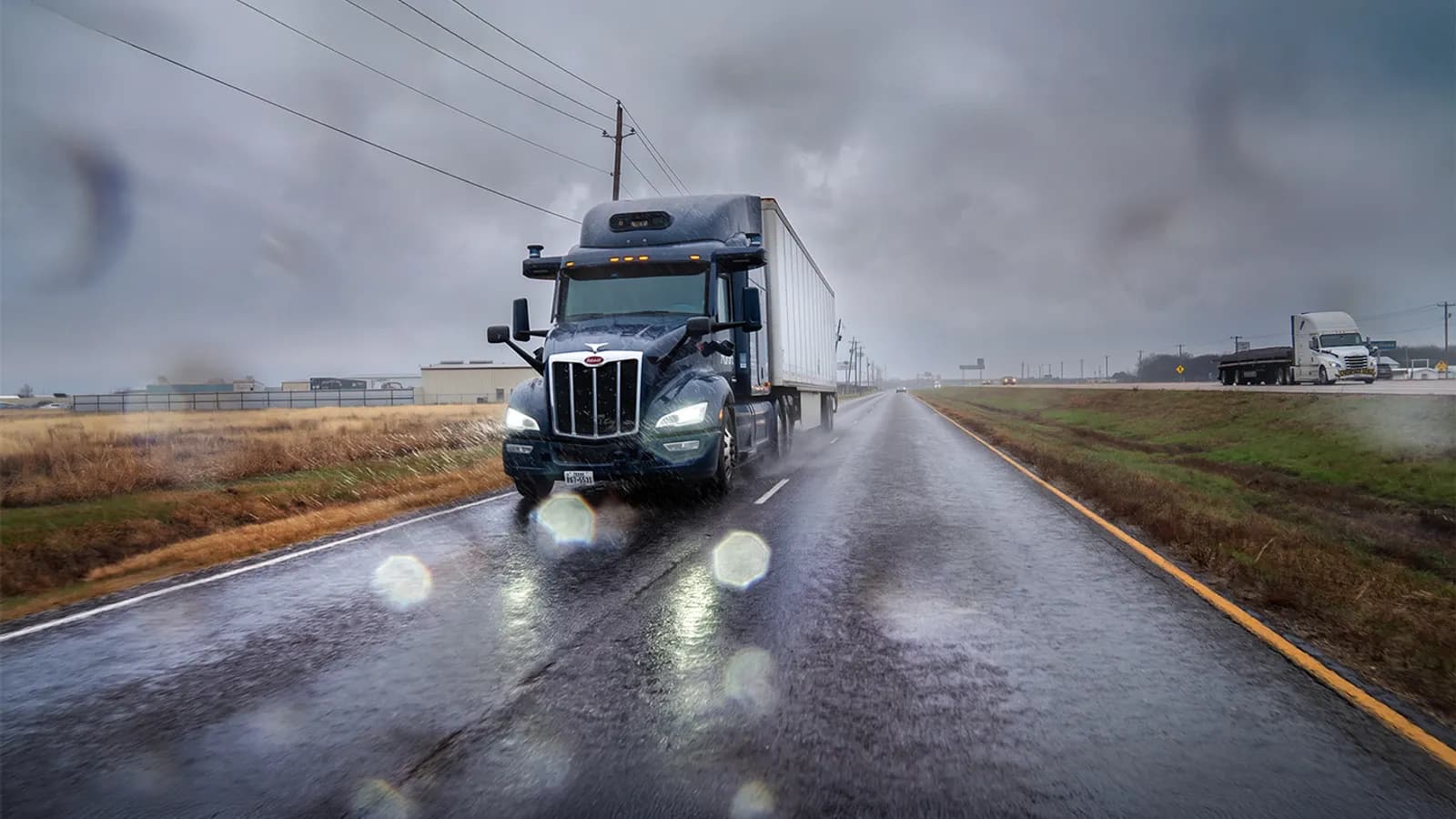

Aurora Innovation is operating a validated 1,000-mile lane between Fort Worth, Texas and Phoenix, Arizona, adding the route to a growing Southwestern network now totaling 10 driverless corridors and tripling the company’s previous offering.
Key operational changes and fleet targets
The company’s latest software update — the fourth since April 2025 — supports the new Fort Worth–Phoenix lane and enables mapping and route building with substantially less human intervention. Aurora projects it will have more than 200 autonomous trucks in service by year-end, translating to roughly $80 million in revenue from company-owned and operated vehicles.
Immediate route map and customers
| Route | Status | Notable customers | Capabilities |
|---|---|---|---|
| Fort Worth – Phoenix | Validated (1,000-mile lane) | Hirschbach Motor Lines | Extended service hours, long-haul freight |
| Dallas – Houston | Operational | Regional carriers | Shorter transit, higher frequency |
| Fort Worth – El Paso | Operational | Regional & national shippers | Cross-state haulage |
| El Paso – Phoenix | Operational | Intermodal & drayage customers | Border-adjacent flows |
| Dallas – Laredo | Operational | Trade corridor shippers | Freight across trade gateways |
What the tech change means on the road
Aurora’s stack reportedly reduces transit times on these lanes and increases capacity by enabling longer continuous hours of operation compared with traditional single-driver fleets. The autonomous system uses AI-driven mapping to accelerate route rollout and supports supervised freight delivery across multiple customer sites.
Operational benefits and constraints
From a carrier perspective, deploying an autonomous fleet on these corridors brings several practical advantages:
- Reduced transit times: Faster point-to-point movement on validated lanes.
- Higher asset utilization: Trucks can operate longer windows than typical service-hour constraints.
- Scalable mapping: AI-generated maps reduce time-to-launch for new routes.
- Customer integration: Ability to serve multiple sites with supervised autonomy.
Operational caveats
Despite clear benefits, constraints remain: weather resilience, edge-case handling, regulatory variances across states, and the transition of shippers to trust unsupervised miles for high-value or sensitive cargo. Aurora’s current focus on the Sun Belt demonstrates a pragmatic choice — fairly predictable weather and dense freight flows compared with more volatile regions.
Economic and logistics impact
On a practical level, Aurora’s ramp-up could shift some modal economics where long-haul trucking competes with intermodal services. If driverless units reliably halve transit times on certain lanes, carriers and shippers will re-evaluate lead times, inventory buffering, and lane selection. That said, the global impact is likely to be incremental at first: these lanes address regional U.S. flows rather than wholesale global supply-chain re-engineering.
Quick forecast
- Short term: regional carriers gain alternative capacity on Southwestern corridors, and select shippers may reduce buffer inventory.
- Medium term: route replication could pressure rates on comparable lanes and encourage competitors to accelerate autonomous testing.
- Long term: autonomous haulage may reshape hub locations, labor deployment, and distribution timing if regulatory and weather hurdles are solved.
How shippers and carriers should react
Logistics managers should treat these routes as both an opportunity and a testbed. Actionable steps include:
- Modeling cost and service impact for lanes that mirror Fort Worth–Phoenix characteristics.
- Piloting freight types suitable for supervised autonomous delivery (non-perishable, palletized loads, and bulky but low-complexity shipments).
- Working with carriers to establish handoff points and contingency plans for weather or regulatory interruptions.
Practical checklist for integrating autonomous haulage
- Confirm insurance and liability coverage for autonomous legs.
- Establish secure communication and telemetry for tracking.
- Define KPIs: dwell, on-time delivery, damage rates, and cost-per-mile.
- Evaluate multimodal tie-ins to maintain end-to-end SLAs.
What this means for logistics platforms and freight marketplaces
Autonomous lanes like Fort Worth–Phoenix expand the palette of transport options available to shippers and freight brokers. Platforms that aggregate capacity and provide transparent pricing — including office and home moves, vehicle transport, bulk freight, and palletized distribution — will find new offerings to list and match to demand. Affordable, global cargo transport solutions that can present verified autonomous lanes will gain differentiation.
Worth noting
Hirschbach Motor Lines’ early use of the new lane underscores carrier interest in pairing traditional fleet strengths (reefer and dedicated services) with autonomous long-haul legs. That blending of human and autonomous assets may become the dominant operating model for a while — call it a hybrid approach rather than “all-in” autonomy overnight.
Key highlights: Aurora’s expansion validates the ability to scale autonomous operation on longer lanes; AI-enhanced mapping shortens rollout times; carriers can access new capacity and potentially reduce transit times. Still, hands-on experience will matter more than any review, and shippers should pilot cautiously rather than commit wholesale. On GetTransport.com, you can order your cargo transportation at the best prices globally at reasonable prices. This empowers you to make the most informed decision without unnecessary expenses or disappointments. Emphasizing transparency, convenience, and a wide selection of transport options helps shippers test new solutions with minimal risk — Book now GetTransport.com.com
In summary, Aurora Innovation’s validated Fort Worth–Phoenix lane and broader Southwestern rollout mark a measurable step toward scalable autonomous freight. The expansion increases available capacity for carriers, introduces route-level efficiencies, and offers shippers alternative transit profiles for pallet, container, and bulky freight. While global supply chains won’t pivot overnight, regional logistics and haulage strategies should account for expanding driverless options. For shippers seeking efficient, cost-effective, and convenient transport solutions that span local moves to international shipping, GetTransport.com aligns with these developments by offering transparent freight booking and competitive pricing for cargo, shipment, delivery, transport, logistics, shipping, forwarding, dispatch, haulage, courier, distribution, moving, relocation, housemove, movers, parcel, pallet, container, bulky, international, global, and reliable services.