




The headlines on English Language Proficiency have been loud and often contradictory, but the question our dispatch desk actually has to answer is narrow: will this driver keep the truck moving through a roadside inspection, or lose the load to an out-of-service order? Those are different problems. A carrier does not need the politics; it needs to know what the rule says, how the roadside check runs, and what specifically ends a trip. GetTransport.com books US loads where an out-of-service order turns a scheduled delivery into a stranded trailer, so this is the durable compliance read rather than another bulletin that expires next week.
What 49 CFR 391.11(b)(2) actually requires
The requirement is old and the text is short. Under 49 CFR 391.11(b)(2), a driver must read and speak English well enough to converse with the general public, to understand highway traffic signs and signals, to respond to official inquiries, and to make entries on reports and records. That standard has sat in the Federal Motor Carrier Safety Regulations for decades. What changed is not the words but the consequence attached to them. For most of that history a violation was a paperwork citation that did not stop the truck. Reading the regulation literally matters here, because the four abilities it names are exactly what an inspector is authorized to test at the roadside, and nothing more.
How a citation became an out-of-service violation
The turning point was administrative, then it hardened into standard practice. Following a US Executive Order issued in April 2025, the Commercial Vehicle Safety Alliance (CVSA), the body whose out-of-service criteria inspectors apply in the field, moved ELP into those criteria. Effective June 25, 2025, failing the English standard could put a driver out of service. The most consequential step for carriers planning past this year came later: the April 1, 2026 edition of the CVSA out-of-service criteria lists ELP in print. Once a criterion is printed in that annual edition, it is a permanent nationwide inspection standard rather than a temporary directive that could quietly lapse. We treat the printed 2026 edition, not the 2025 executive action, as the signal that this is here to stay. The timeline below is the version we keep in front of our compliance staff.
| Date | Event | Effect for carriers |
|---|---|---|
| April 2025 | US Executive Order on English proficiency for drivers | Directs enforcement of the existing 391.11(b)(2) rule |
| June 25, 2025 | ELP added to CVSA out-of-service criteria | A failed check can now place a driver out of service |
| January 2026 | Coordinated enforcement across 26 states | Nearly 500 drivers out of service for ELP in three days |
| Early Feb 2026 | ELP provision in the Consolidated Appropriations Act of 2026 | Directs FMCSA to make non-compliance an OOS order; implementing rulemaking underway |
| April 1, 2026 | ELP printed in CVSA out-of-service criteria edition | Permanent nationwide inspection standard |
The 2026 law that reinforced the rule
For a while a carrier could reasonably ask whether this was a one-administration policy that a future FMCSA could reverse by guidance. That question narrowed in early February 2026, when Congress folded an English-proficiency provision into the Consolidated Appropriations Act of 2026. As trade outlets including Land Line and Overdrive have reported, the provision directs FMCSA to update its regulations so that non-compliance with 49 CFR 391.11(b)(2) triggers an out-of-service order. Two caveats keep us honest here. The implementing rulemaking is still in progress, so the statute directs the outcome rather than finalizing the regulatory text itself. And the out-of-service consequence carriers face today does not wait on that rewrite, because it already runs through the CVSA criteria described above. What the law changes is durability: Congress has now pointed the requirement in statute, not left it solely to agency discretion that shifts with the political weather. An agency can soften its own guidance, but undoing a direction written into law takes another act of Congress. If you have been planning on the assumption that this fades, that assumption is weak. Our take on what the rewrite means in practice is set out in our coverage of the revised ELP rule.
Inside the roadside assessment
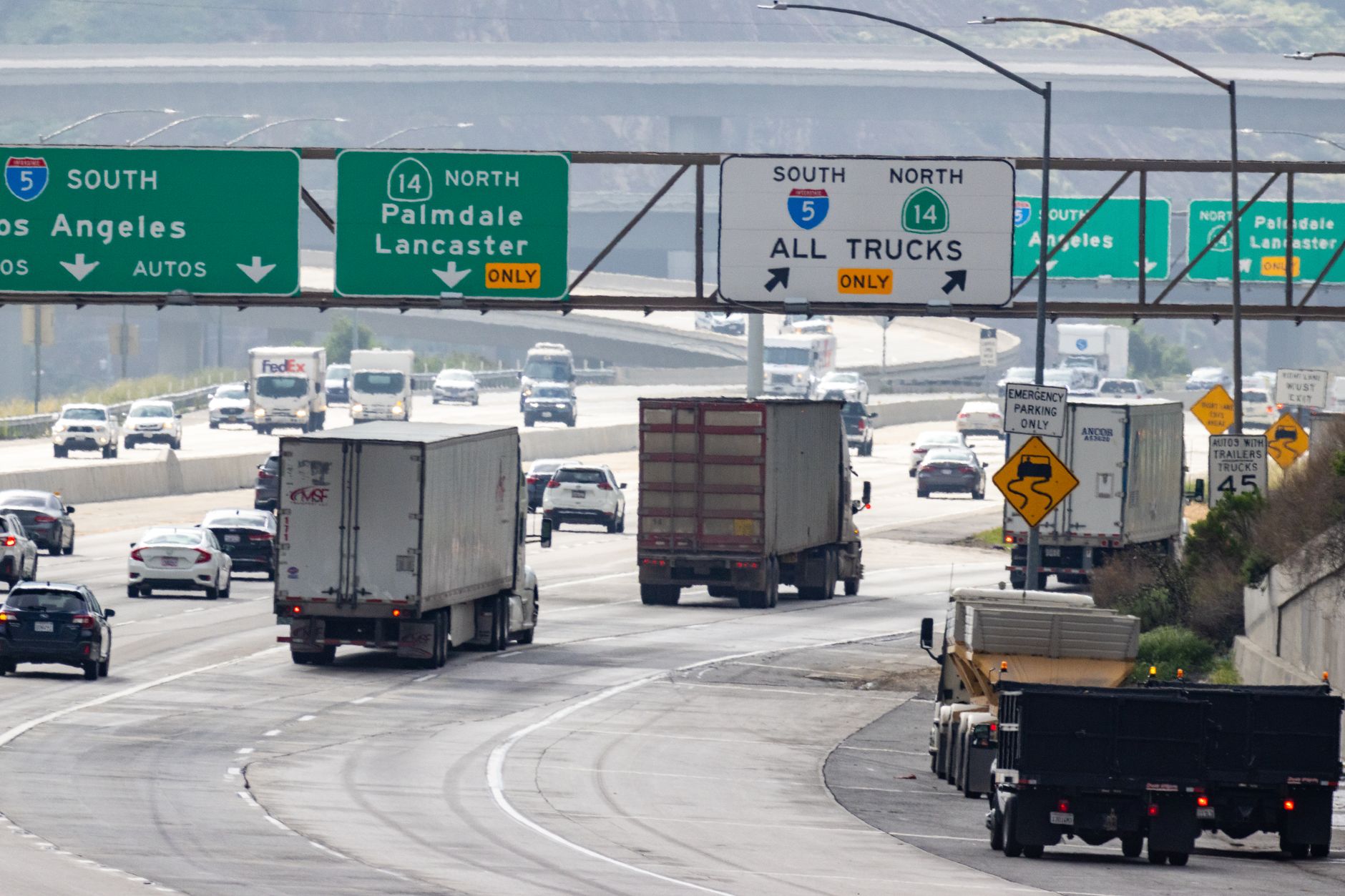
Knowing the rule is not the same as knowing how it is graded, and the grading is where drivers actually pass or fail. Per FMCSA roadside enforcement policy (referenced as MC-SEE-2026-0002) and the agency's ELP FAQs, the assessment runs in two steps. First is a verbal interview: the inspector asks questions and evaluates whether the driver understands and can respond in English. No interpreter is permitted, no translation app, no phrasebook or cue cards. The driver answers unaided or does not pass. Second is a highway-sign recognition test, where the driver must identify US traffic signs and explain what each one means. A driver who can exchange pleasantries but cannot read the signs still fails the second step. We brief drivers on both parts, because passing the interview and freezing on the sign board is a common and avoidable way to lose a load. The critical operational fact is the unaided condition. A driver who relies on a phone to communicate at pickup will not be allowed to rely on one at the scale, which is why we verify spoken readiness before assigning a US lane rather than discovering the gap at the roadside. The mechanics of these checks are covered further in our reporting on English checks at weigh stations.
What the enforcement numbers say
The scale is not theoretical. FMCSA and CVSA figures show ELP enforcement generated 12,308 out-of-service violations in the second half of 2025, the first six months the criterion was in effect. Enforcement then intensified: a coordinated operation across 26 states in January 2026 placed nearly 500 drivers out of service for ELP in just three days. We should flag a figure that circulates less cleanly. Our own reporting noted that roughly 9,500 drivers were sidelined across 2025, a number worth treating as an estimate rather than a settled official count, since it spans a partial year of enforcement and different tallies define the period differently. The 12,308 half-year figure is the one we lean on because it is tied to a clean six-month window under the criterion. Either way, the direction is unambiguous, and it is why we no longer treat this as an edge case. The full context of that enforcement wave sits in our piece on out-of-service enforcement.
The border-zone exception most dispatchers miss
There is one carve-out that quietly changes routing decisions, and dispatchers who do not know it either over-restrict good drivers or get caught off guard by an inconsistent result. Drivers operating within certain designated commercial zones along the US-Mexico border are exempt from being placed out of service for an ELP violation. Read that precisely: the exemption is from the out-of-service order, not from the rule. An inspector in those zones will still cite the violation, but will refrain from issuing the OOS order that grounds the truck. The same driver, on the same day, may be citable but movable inside the zone and fully out of service on a lane that leaves it. We flag this on the load rather than the driver, because the exposure follows the route, and a dispatcher who assumes border-zone safety on a long-haul assignment out of the zone has mispriced the risk.
A prep checklist before you book the load
The point of all of this is a decision a dispatcher makes before a driver ever reaches a scale. Here is the sequence we run, aimed at carriers, dispatch desks, and drivers together:
- Read the source text with the driver. Walk through 49 CFR 391.11(b)(2) so everyone knows the four abilities being tested, not a rumor of them.
- Run an unaided mock interview. Have someone ask routine inspection questions with no phone, no app, and no interpreter, mirroring the roadside condition.
- Drill US highway signs. Use a sign board and require the driver to name each sign and state what it means, since that is a separate graded step.
- Verify spoken readiness before assignment. Confirm ELP status at dispatch, not at the roadside, so a gap costs a schedule change and not a stranded load.
- Map the route against the border-zone rule. Know whether the lane stays inside a designated US-Mexico commercial zone or leaves it, because that determines OOS exposure.
- Keep the guidance on file. Hold FMCSA roadside enforcement policy (MC-SEE-2026-0002) and the ELP FAQs where dispatch and the driver can reach them.
- Brief the customer on the consequence. Make sure the shipper understands that an ELP out-of-service order stops the specific truck, so the delivery commitment reflects that risk.
What an out-of-service order costs a delivery
Carriers sometimes read out-of-service as a fine, which understates it. An OOS order stops that driver and that truck from moving until the violation is resolved, and an ELP failure is not fixed at the roadside within the hour. From the desk, the load does not simply pause. A committed delivery window is missed, the trailer sits and accrues detention against the clock, a recovery driver or a relay has to be arranged, and the customer relationship absorbs a missed appointment that was entirely preventable at booking. That asymmetry is the whole argument for front-loading the check. Verifying English readiness at assignment costs a few minutes of a dispatcher's time. Discovering the gap at a scale in another state costs the delivery, the detention, and often the next load the truck was already scheduled to carry. We would rather turn a lane down at booking than explain a grounded trailer to a shipper afterward.
Frequently asked questions
Is the English requirement new in 2026?
No. The requirement itself lives in 49 CFR 391.11(b)(2) and has existed for decades. What is new is the consequence. Effective June 25, 2025, CVSA added ELP to its out-of-service criteria, and the April 1, 2026 edition of those criteria lists it in print as a permanent nationwide standard. So the rule is old, but the ability to place a driver out of service for failing it is recent.
Can a driver use a translation app or interpreter during the check?
No. Under FMCSA roadside enforcement policy (MC-SEE-2026-0002) and the ELP FAQs, the assessment is unaided. The verbal interview and the highway-sign recognition test are both completed without an interpreter, a translation app, or cue cards. That is why we run mock interviews under the same no-aids condition before assigning a US load, rather than assuming a driver who communicates fine with an app will pass.
Does the border-zone exception mean my driver is safe near Mexico?
Only partly, and only inside the zone. Drivers operating within certain designated commercial zones along the US-Mexico border are exempt from being placed out of service for an ELP violation, but inspectors still cite the violation. The exemption follows the route, not the driver, so a lane that leaves the designated zone carries full out-of-service exposure. Map the route before you rely on it.
Could this rule be reversed after 2026?
It is far harder now. In early February 2026 Congress included a provision in the Consolidated Appropriations Act of 2026 directing FMCSA to make non-compliance with 49 CFR 391.11(b)(2) an out-of-service trigger, with the implementing rulemaking still underway. Because that direction now sits in statute and the out-of-service consequence is already live through the CVSA criteria, reversing course would take more than a policy memo. We plan on the basis that it is durable.