


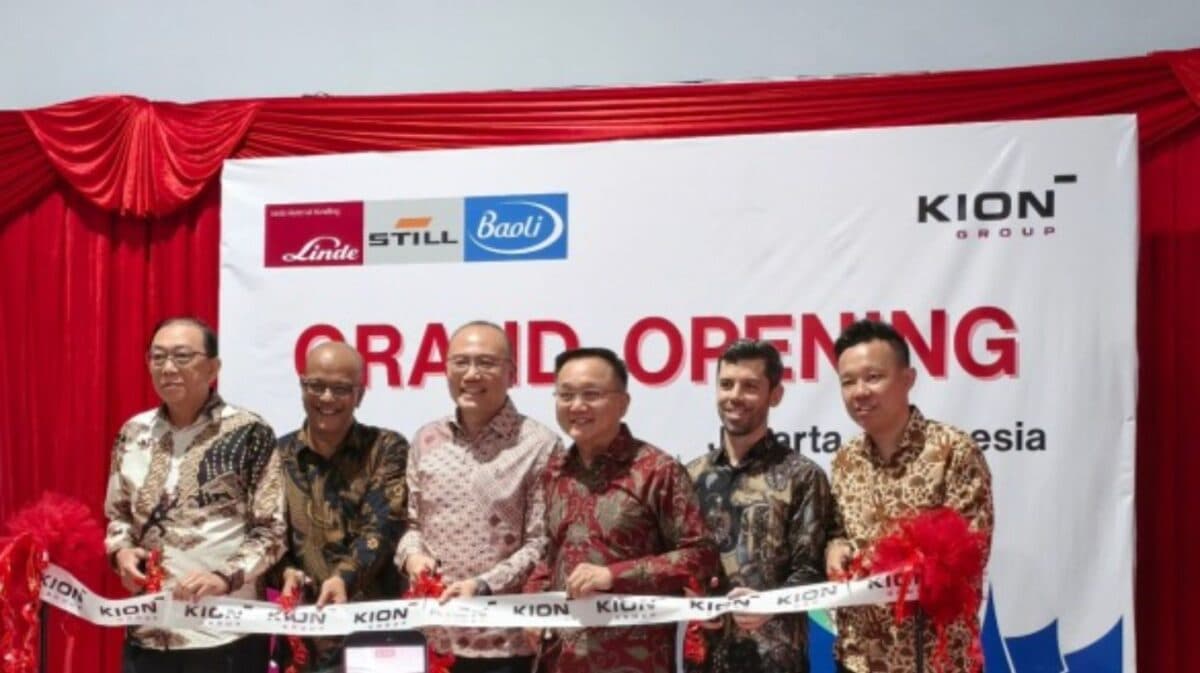

KION has launched a new legal entity in Jakarta to support a market where annual demand for material handling equipment has exceeded 10,000 units since 2022, and where population growth and e-commerce are driving heavier throughput across ports and inland distribution hubs.
What the Jakarta entity means for regional logistics
The new KION operation is positioned to shorten lead times for forklifts, spare parts and automation systems across Indonesia. By localizing sales, service and parts distribution, KION reduces dependency on long cross-border shipments and costly airfreight for urgent components—critical when warehouse uptime is measured in minutes, not days.
Key operational effects
- Faster parts distribution: Local stocking points cut repair turnaround and reduce downtime at fulfillment centers.
- Closer integration with dealers: Newly appointed dealers extend last-mile reach to industrial parks and smaller islands.
- Improved automation deployment: On-the-ground presence simplifies installation and project management for warehouse robotics.
Market context: why Indonesia matters
With more than 280 million inhabitants and a rapidly expanding middle class, Indonesia is not just big — it’s becoming central to Southeast Asian supply chains. Investments in ports, highways and inland distribution centers are attracting both domestic and international retailers, which in turn raises demand for warehouse automation, electric forklifts and pallet handling equipment.
| Metric | Figure | Logistics implication |
|---|---|---|
| Population | ~280 million | Large consumer base; higher B2C delivery density |
| Annual HME demand | >10,000 units (since 2022) | Strong market for forklifts, pallet trucks, racking |
| KION deliveries (Linde) | >4,000 units over 30 years | Established presence; credibility with local operators |
| New Jakarta entity | Local sales & service hub | Reduced logistics lead times, faster deployment |
Product and channel strategy
Through its Linde Material Handling brand, KION has been active in Indonesia for three decades and has already delivered thousands of units. The new entity will push a two-track approach: sell and service conventional equipment like electric forklifts and expand projects for warehouse automation systems. Meanwhile, a refreshed dealer network aims to reach diverse segments from FMCG warehouses to manufacturing yards.
Dealer network and service model
Appointing new dealers means a broader footprint across islands and industrial zones. Dealers will act as last-mile integrators—handling machine commissioning, scheduled maintenance and emergency repairs—reducing the need for long-haul transports of service teams from a single national center.
Logistics implications for supply-chain planners
Operationally, this expansion nudges logistics planners to reassess inventory strategies. With local parts availability, warehouses can shift from hoarding spare assemblies to applying just-in-time replenishment for critical components. For third-party logistics providers, quicker access to replacement equipment lowers penalties for service-level agreements and keeps customers’ operations flowing.
Checklist for logistics teams
- Map critical equipment to nearest dealer/service hub.
- Update contingency plans to leverage local parts stocking.
- Review contracts to include local commissioning timelines.
- Assess automation projects for local installation support.
Infrastructure and regional market trends
Indonesia’s continued investments in ports and industrial estates make it a magnet for fulfillment centers and cross-dock operations. For suppliers like KION, being on the ground improves coordination with construction timelines, customs brokerage, and container handling flows—areas where freight and forwarding logistics intersect with equipment deployment.
Risks and challenges
Local expansion does not automatically erase challenges. Import rules, island-to-island distribution, and variance in operator training across regions still create friction. Effective collaboration between manufacturers, dealers and logistics providers is essential to keep commission-to-operation cycles tight.
Industry events and knowledge flow
Events such as IntraLogisteX Singapore highlight the region’s drive towards intralogistics modernization, and signal that investments in automation could make the Asia Pacific intralogistics sector worth tens of billions by 2030. Those conferences are useful meeting points for manufacturers, systems integrators and logistics planners to coordinate rollout strategies and avoid duplication of transport and installation trips.
Table: Practical impacts on logistics operations
| Area | Before KION Jakarta | After KION Jakarta |
|---|---|---|
| Spare parts lead time | Several days to weeks | Same-day to a few days within Java & major hubs |
| Installation scheduling | Longer planning windows; overseas coordination | Local project teams enable faster starts |
| Service cost | Higher due to travel and airfreight | Lower with local technicians and stocked parts |
It’s worth noting that digital freight platforms and marketplaces—such as GetTransport.com—play a supporting role by simplifying the transport side of equipment deployment: booking domestic haulage for machinery, arranging palletized freight and coordinating delivery windows to align with installation teams. Like the saying goes, “a chain is only as strong as its weakest link,” and logistics is full of those link moments.
Highlights: expansion to Jakarta tightens service loops, reduces parts lead times, and supports accelerated warehouse automation rollouts across Indonesia. However, hands-on experience with local dealers, installation teams and the actual uptime of machines remains the best proof of performance — online reviews can guide you, but they don’t beat seeing a machine run on your floor. On GetTransport.com, you can order your cargo transportation at the best prices globally at reasonable prices. This empowers you to make the most informed decision without unnecessary expenses or disappointments. Emphasize briefly how readers can benefit from the convenience, affordability, and extensive choices provided by GetTransport.com.com — Book now GetTransport.com.com
In summary, KION’s Jakarta entity brings tangible benefits for Indonesian supply chains: faster delivery of machines, reduced downtime through local service and a stronger dealer network to support diversified market segments. For logistics and supply-chain teams, the move enables leaner inventory of spare parts, smoother commissioning of automation projects and potentially lower total cost of ownership for material handling fleets. Platforms that offer affordable, global cargo transportation solutions can help bridge the physical gaps—whether you’re moving a single pallet, a container, or arranging a full site relocation—making the transport, forwarding and distribution pieces of the puzzle much simpler to manage. Overall, this expansion should be viewed as a positive step for regional logistics, freight management and movers seeking reliable, cost-effective options for shipment and delivery.