


 Nederlands
  English (UK)
  Русский
  العربية
  日本語
日本語  한국어
한국어  Magyar
  Türkçe
  Español
  Čeština
  Svenska
  Português
  Ελληνικά
  Suomi
Suomi  Română
  Italiano
  Français
  Polski
  Українська
  Deutsch
  简体中文
简体中文  Slovenčina
  Ocean Freight GRIs Increase and Transpacific Air Cargo Rates Climb Sharply in Final 2025 Peak Weeks">

Wekelijkse samenvatting van de vrachtmarkt
November and December of 2025 have been marked by notable movements in global freight rates, especially in ocean and air cargo sectors. Ocean freight markets are witnessing fresh General Rate Increases (GRIs) on major trade lanes, while transpacific air cargo rates are surging amid peak season demand. This summary dives into these trends and their implications, particularly focusing on the transpacific routes and the Asia-Europe trade lanes.
Ocean Freight Rate Movements
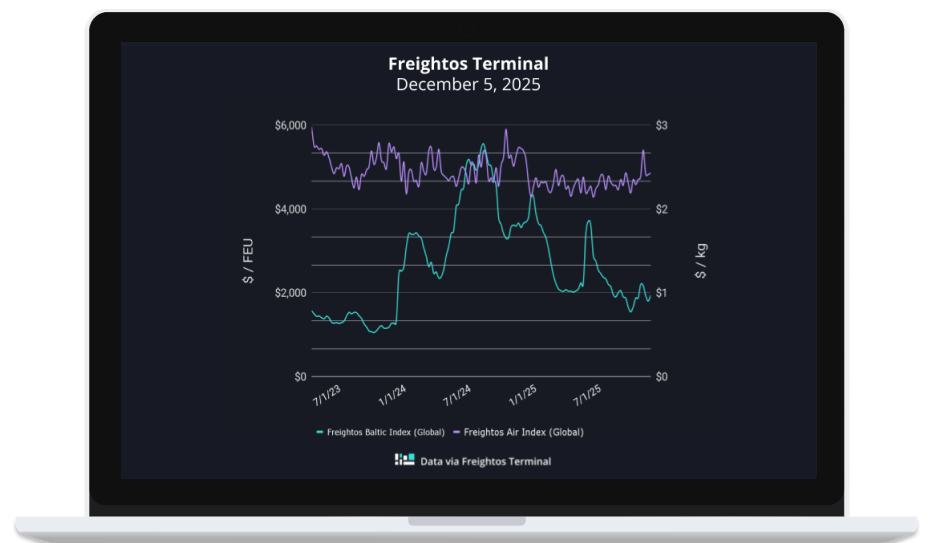
Freightos Baltic Index Snapshot
| Route | Weekly Rate Change | Current Rate ($/kg or $/FEU) |
|---|---|---|
| China to Northern Europe | Decrease 12% | $3.64/kg |
| Northern Europe to North America | Increase 2% | $2.48/kg |
Rates between China and Northern Europe showed a 12% dip, while the lane from Northern Europe to North America saw a modest 2% increase. These shifts reflect the complex dynamics of supply and demand, especially as carriers adjust their capacity and rates in the face of uneven volume flows.
Container Market and Red Sea Routing
There are tentative signs that container shipping through the Red Sea might see a cautious revival. Certain Ocean Alliance services, including those by CMA CGM, have started navigating the Suez Canal on backhaul voyages under naval escort, illustrating cautious moves towards normalized routes after disruptions. Although this isn’t a full rebound yet, the eventual return of container flows through this vital corridor could inject much-needed capacity back into a market currently grappling with oversupply.
Transpacific Ocean Rates: A Rollercoaster Ride
After bottoming out at around $1,400 per FEU on the West Coast in early October, transpacific container rates have been on a wild ride. Carriers have deployed a mix of capacity management and rate increases that resemble a slow-motion rollercoaster—prices rise, fall, and rise again in incremental waves.
Mid-October and early November saw rates spike to nearly $3,000/FEU, only to retreat sharply to $1,700 by month-end. December kicked off with another uptick, bringing rates to approximately $2,100/FEU and even climbing further to $2,200 by the second week of the month for West Coast shipments. On the East Coast, rates surged past $3,000/FEU.
An emerging pricing tactic involves carriers rolling out smaller weekly increases rather than bi-monthly GRI hikes, banking on the market’s willingness to accept modest rises rather than steep, sudden jumps.
Outlook on Ocean Volumes and Market Demand
Despite these rate fluctuations, overall volume is expected to be at the lowest point of the year. Diverging opinions abound regarding next year’s demand—some forecast a US restocking cycle to boost ocean volumes, while others predict continued year-on-year declines, influenced by lingering trade tensions and consumer caution.
North America’s ocean import volumes have softened, partly due to trade war frontloading effects now fading. Conversely, European imports via ocean freight have held steadier, buoyed by China’s pivot from the US towards European markets. Data shows that ocean imports to Europe remain slightly up year-over-year, although Asia-Europe volumes have seen a mild decline compared to last year.
Asia-Europe Trade Lanes and GRIs
In Q4 2025, carriers have had greater success pushing up Asia-Europe rates than on transpacific routes, aided by aggressive blanked sailings—a strategy to control capacity as contract negotiations for the annual ocean contracts conclude.
- Asia-Europe rates rose about 40% to an average of $2,463/FEU through late November
- Asia-Mediterranean rates climbed 56% to $3,366/FEU, with a fresh $500/FEU bump in early December
- Additional GRIs are announced for mid-December, with goals to push Northern Europe rates to $3,500/FEU and Mediterranean prices beyond $4,200/FEU
Surge in Transpacific Air Cargo Rates
As the air cargo market barrels into the closing weeks of the 2025 peak season, transpacific demand has shown remarkable strength. The Freightos Air Index logs a jump from $5.30/kg in mid-October to more than $7.50/kg by early December—already topping last year’s peak of $7.30/kg during the final rush.
Demand is particularly robust on China-US lanes, while Asia-Europe air freight rates have softened, reflecting shifting e-commerce focus towards Europe. This has prompted some capacity to divert from the transpacific routes to Asia-Europe, helping to restrain upward rate pressure on the latter.
Impact of Regulatory Changes on Air Cargo
Another noteworthy factor affecting air cargo flows is the upcoming closure of de minimis import exemptions by the EU and UK, prompting many countries to introduce handling fees on low-value shipments. The US experienced a temporary slump in China-US e-commerce air cargo volumes following similar de minimis changes, but demand has since rebounded as platforms adapted their logistics strategies.
Logistics Implications of Current Freight Trends
The oscillation in ocean rates and the sharp climb in air freight prices underline a freight market that’s far from stable as the year winds down. These fluctuations create challenges for logistics planners who must balance cost control against capacity and timing considerations.
For instance, spot hikes in ocean freight and air cargo rates during peak windows can ripple through supply chains, impacting everything from inventory holding costs to final delivery prices. The relative strength of air freight on transpacific lanes amidst a weaker ocean demand speaks to an ongoing shift in how cargoes are prioritized and routed, especially for time-sensitive shipments.
The Role of Market Adaptability
Carriers’ strategies of introducing smaller, incremental GRIs may signal a refining of freight pricing, aiming to find a sweet spot that shippers can swallow without pushing volumes into freefall. Meanwhile, the gradual return of Red Sea transit options points to logistical recalibrations tied to route security and geopolitical stability, which can directly affect global freight forwarding decisions.
Summary of Key Freight Rate Changes
| Handelsroute | Rate Trend | Huidig tarief | Remarks |
|---|---|---|---|
| China to N. Europe | Down 12% | $3.64/kg | Softening demand |
| N. Europe to N. America | Up 2% | $2.48/kg | Stable with slight uptick |
| Transpacific Ocean (West Coast) | Volatile, up 22% recently | ~$2,200/FEU | Incremental weekly GRIs |
| Asia-Europe Ocean | Up 40% | $2,463/FEU | Aggressive blank sailings |
| Asia-Mediterranean Ocean | Up 56% | $3,366/FEU | Further GRIs pending |
| China-US Air Cargo | Up 42% | >$7.50/kg | Pieksaisonstijging |
| China-Europe Air Cargo | Down 12% | $3.64/kg | Stable year-over-year |
Why Personal Experience Trumps All
While detailed data and market analysis provide a great snapshot of freight rate movements, nothing quite compares to firsthand experience coordinating shipments and managing logistics amid fluctuating prices and capacity. The unpredictable nature of international trade means every shipment can bring surprises—whether it’s sudden rate hikes or capacity bottlenecks.
Platforms like GetTransport.com step into this picture by offering a transparent and user-friendly interface to book cargo transport globally at competitive prices. Whether moving office equipment, furniture, vehicles, or bulky freight, the ability to compare rates and schedule shipments with ease lets logistics managers adapt quickly to market changes without unnecessary cost headaches.
With a vast roster of carriers across air and ocean freight, GetTransport.com empowers users to avoid budget blowouts and delivery delays—proving that convenience and affordability don’t have to be mutually exclusive in today’s complex logistics landscape. Book your Ride with GetTransport.com.
Implications for Global Logistics and Looking Ahead
Although the flurry of GRIs and air cargo rate surges may seem like just another market cycle, they remind us how critical it is for logistics providers and shippers to stay agile. While these rate shifts might not drastically alter the global freight landscape long-term, they do influence decisions on shipment timing, mode selection, and supply chain resilience.
GetTransport.com closely monitors these developments to keep pace with the evolving market—helping customers navigate the bumps smoothly. Start planning your next delivery and secure your cargo with GetTransport.com.
Conclusie
The closing months of 2025 have showcased a dynamic freight market, with ocean carriers rolling out continued GRIs amid volatile volume, especially on the transpacific lanes, while air cargo rates soared to new peak-season highs. Europe’s ocean imports hold steadier than North America’s, reflecting shifting trade patterns and market focus. Meanwhile, adjustments around route security and regulatory changes add complexity but also opportunity for those in logistics.
With so many moving parts, successful freight forwarding demands access to reliable, flexible, and cost-efficient transport solutions. Platforms like GetTransport.com shine by offering extensive options across ocean and air freight, transparent pricing, and easy booking—whether for bulky shipments, palletized cargo, or vehicle transport. This simplifies the logistics puzzle, helping meet global shipping needs smoothly and affordably.