


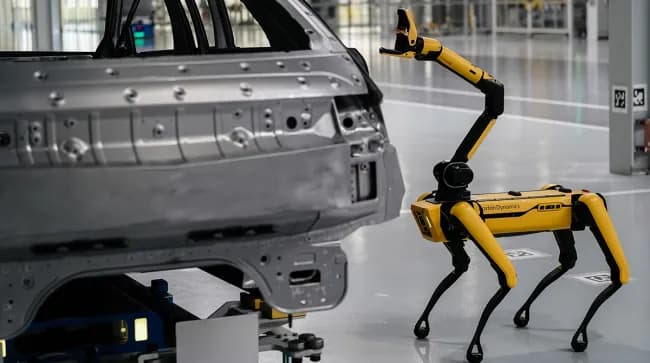

Hyundai will build a 5.8 trillion-won AI data center equipped with 50,000 GPUs at Saemangeum to accelerate autonomous vehicle software, robot learning and connected manufacturing workflows.
Investment breakdown and site selection
The full package totals roughly 9 trillion won (about $6.3 billion) and is split across several coordinated facilities in the Saemangeum area, roughly 168 miles southwest of Seoul. The project includes an AI data center, a hydrogen production plant based on water electrolysis, a solar power installation, and Hyundai’s first domestic robot factory intended for mass production of wearable and industrial robots.
| Component | Planned Spend (won) | Primary Purpose |
|---|---|---|
| AI data center | 5.8 trillion | 50,000 GPUs to support autonomous driving and continuous robot learning |
| Hydrogen electrolysis plant | 1 trillion | Produce ~80 tons/day of green hydrogen for mobility and industry |
| Solar power | 1.3 trillion | Renewable power to run AI and hydrogen facilities |
| Robot factory | 400 billion | Mass-produce logistics and wearable robots; seed a parts cluster |
Partners and tech stack
Hyundai signed a multi-agency investment agreement and is partnering with Nvidia to deploy Blackwell accelerators inside the AI cluster. Boston Dynamics, a Hyundai unit, continues to move production-ready platforms forward — the Atlas humanoid and Spot platforms were referenced in recent demonstrations — but the new robot factory at Saemangeum will focus primarily on logistics and industrial robots as well as wearable assist devices.
What this means for logistics and supply chains
On paper, the Saemangeum initiative reads like a vertical stack that ties compute, renewable power, hydrogen fuel and robotics into a single industrial corridor. That integration has discrete implications for transport, distribution and freight operations:
- Local freight demand spike: Construction and equipment delivery will increase short-term haulage for containers, heavy-lift trucks and specialized couriers into Saemangeum.
- On-site automation: Mass-produced logistics robots could reduce intralogistics truck runs inside facilities, shifting demand from short-haul haulage to automated pallet conveyors and autonomous movers.
- Green fuel logistics: Daily output of ~80 tons of green hydrogen introduces new requirements for safe transport, storage and distribution, including specialized tanker trailers or hydrogen refueling infrastructure for regional fleets.
- Data-driven dispatch: A 50,000-GPU AI center will enable higher-fidelity routing models, predictive maintenance for fleets, and potentially real-time coordination between robots and trucks.
Operational and regulatory considerations
Scaling from prototypes to mass production always exposes gaps: spare parts supply chains, skilled operator pools, and regulatory frameworks for robot deployment. Expect an uptick in demand for:
- Qualified robotics technicians and logistics integrators to commission systems.
- Certified hydrogen haulage and storage providers complying with safety rules.
- Cybersecurity and data governance for AI models that influence vehicle controls and warehouse operations.
Where bottlenecks might appear
From my own time watching projects go live, the devil is often in the last mile—literally. Shipping modular robots, GPUs and hydrogen equipment to a regional hub can be held up by limited heavy lifting resources, port handling queues, or a shortage of specialized transport packaging. In short, if you build it but can’t move it efficiently, you slow the whole machine down. That's logistics reality—no two ways about it.
Jobs, regional strategy and economic ripple effects
The government projects about 71,000 new jobs from the combined plan, spanning construction, manufacturing, R&D and service roles. The initiative also fits policy goals to decentralize industry away from Seoul and create new clusters for robot parts suppliers and AI talent.
- Cluster formation: Suppliers for actuators, sensors and power electronics are likely to relocate or expand nearby.
- Talent pull: Universities and technical institutes in the region will adjust curriculums to feed the new demand for robotics and AI engineers.
- Export potential: If production scales, Saemangeum could become a node for exporting robots, related parts and hydrogen technologies — all of which affect international shipping and customs flows.
Practical scenarios for carriers and freight forwarders
Carriers should start planning now for a few predictable shifts:
- More frequent container and palletized shipments of electronics and robot components.
- New demand for specialized bulk hydrogen handling equipment, including ISO tank containers adapted for hydrogen.
- Opportunities for last-mile robotics service providers to partner with logistics firms on hybrid human-robot delivery models.
At the end of the day, the Saemangeum project is a classic case of industrial convergence: computing power, renewable energy, fuel chemistry and robotics coming together. It's exciting, but as the saying goes, the proof of the pudding is in the eating — pilots must scale cleanly for the promised efficiencies to arrive.
In a short forecast on how this news could impact global logistics: the announcement is regionally significant and could become a notable node for Asia-Pacific supply chains, but it is not a single-handed disruptor of global freight markets today. That said, the combination of massive GPU compute and mass-produced robotics could accelerate automation adoption in warehouses and ports worldwide—so we watch closely. This development is still relevant to us, as GetTransport.com aims to stay abreast of all developments and keep pace with the changing world. On GetTransport.com, you can order your cargo transportation at the best prices globally at reasonable prices. Book now GetTransport.com.com
Key takeaways: Hyundai’s Saemangeum plan ties a 50,000-GPU AI hub to renewable energy, hydrogen production and a robot factory; it promises job creation, supplier clustering, and tangible shifts in local and regional freight patterns. Even the best reviews and the most honest feedback can’t truly compare to personal experience — seeing shipments unload, robots roll off a line, and hydrogen tankers couple up is something you have to observe in the field. On GetTransport.com, you can order your cargo transportation at competitive prices and compare options to avoid surprises and unnecessary costs. GetTransport.com’s transparency and convenience help shippers, movers and forwarders find the right solution quickly. Book now GetTransport.com.com
Summary: Hyundai’s 9 trillion-won investment creates an integrated industrial hub linking AI compute, robotics manufacturing, hydrogen production and renewable power at Saemangeum. For logistics providers, carriers and freight forwarders this translates into increased container and pallet flows, new safety and handling requirements for hydrogen haulage, and growing demand for intralogistics automation. Whether you’re arranging a parcel, pallet or container shipment, planning a housemove, moving bulky machinery, or organizing international freight, this project underscores the need for reliable partners across shipping, forwarding, dispatch and haulage. Platforms like GetTransport.com simplify the search for cost-effective, reliable transport and logistics services—making it easier to manage shipments, deliveries and relocations in a rapidly evolving industrial landscape.