


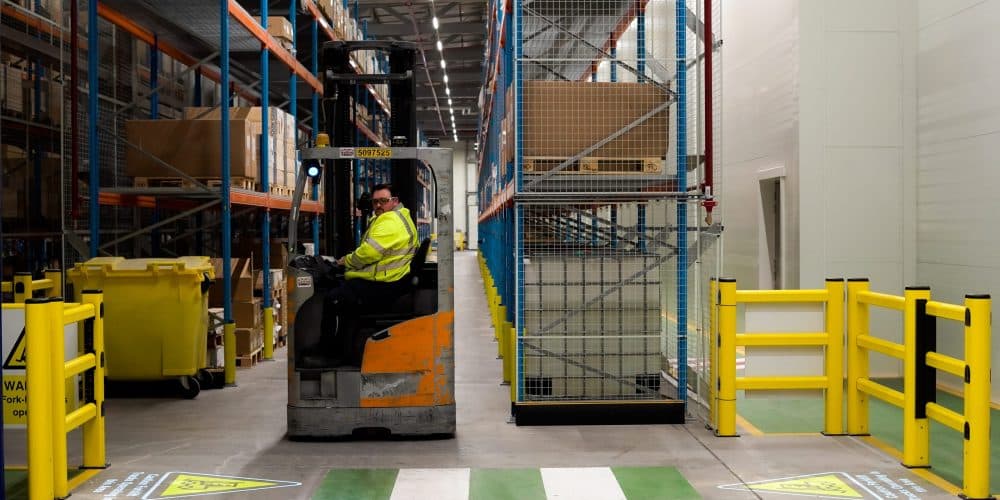

The Health and Safety Executive recorded approximately 2,000 forklift-related accidents in Great Britain in 2018/19, and painted floor markings or vinyl signs routinely need rework twice a year in high-traffic areas where forklifts operate. Projected, light-based signage delivers a persistent, bright image that is largely unaffected by wheel scuffs and pallet traffic, providing a maintenance-free alternative with an advertised five-year operational lifespan.
Why projected signage matters on the warehouse floor
In high-density warehouse zones, the combination of constant forklift movement, abrasive tyres, spilled liquids and loading dock abrasion means that traditional markings fade, lift or become obscured. That loss of clarity increases the risk of near-misses and reduces the effectiveness of designated walkways and exclusion zones. Light-based projection overcomes many of these failure modes because the image is external to the floor surface and remains vivid under traffic.
How projected signage addresses sign blindness
Sign blindness is a documented behavioural issue: workers become habituated to static cues and stop registering them. Dynamic or high-contrast visual cues are more likely to capture attention. Projected imagery—especially when paired with motion sensors—can be set to activate only when a forklift approaches a pedestrian route, making warnings both timely and harder to ignore.
Practical examples on-site
Light-based projections are typically used to mark zebra crossings, warning triangles, vehicle route arrows and no-go zones. In practice, facilities that adopt projection mount the projectors above roller doors, along traffic corridors or on gantries where the projected image lines up with the intended floor location. Automation via sensors can display messages only when relevant traffic is detected, reducing the risk of overexposure.
Comparing projected signage with traditional methods
| Feature | Paint/Vinyl Markings | Projected Signage |
|---|---|---|
| Durability under forklift traffic | Low — prone to abrasion and fading | High — image unaffected by floor wear |
| Maintenance frequency | Typically semi-annual refreshes | Minimal — projectors rated for multi-year operation |
| Visibility and attention capture | Static — risk of sign blindness | Dynamic — can be sensor-activated |
| Installation disruption | Requires floor works and curing time | Quick mount and alignment — no floor downtime |
| Upfront cost | Lower initial cost | Higher initial investment but lower lifecycle cost |
Benefits and limitations
- Benefits: longer operational life, reduced maintenance, improved visibility, sensor integration, and flexible messaging.
- Limitations: initial capital cost, requirement for stable mounting points and power, sensitivity to extreme ambient lighting if poorly specified.
Implementation checklist for operations teams
- Survey traffic patterns and identify critical pedestrian/vehicle interaction points.
- Select IP-rated LED gobo projectors sized for ambient light and mounting height.
- Design custom gobos (symbols, arrows, zebra crossings) and plan sensor integration.
- Install mounts and perform alignment trials during off-peak hours.
- Train site personnel on what the projections mean and their activation logic.
- Schedule periodic checks on projector lenses and sensor calibration rather than floor repainting cycles.
Operational impact on logistics and throughput
Clear, dynamic floor messaging reduces hesitation at pedestrian crossings and helps forklift drivers anticipate zones of higher risk. That can translate to fewer stoppages, reduced accident investigation time and marginally improved throughput. Think of it like smoothing a bottleneck with a traffic light—if everyone knows when to stop and when to go because the cue is visible and unambiguous, the flow improves.
Cost vs lifetime value
While projected systems have a higher upfront cost than a coat of paint or adhesive vinyl, lifecycle analysis often favours projection when factoring the labour, downtime and safety costs of repeated refurbishments. The five-year maintenance-free claim frequently used for high-quality projectors can move the total cost of ownership into a more attractive position for busy distribution hubs.
Technical highlights from suppliers
Suppliers in this space typically offer IP-rated LED gobo projectors, custom gobos and sensor suites designed for harsh industrial environments. The technical brief often stresses heat management, ingress protection and optical brightness calibrated to overcome ceiling-mounted ambient lighting—key points when specifying for docks and racked aisles.
Checklist for procurement
- Confirm IP rating and industrial warranties.
- Check lumen output appropriate for mounting height and ambient light.
- Request case studies for similar facility types (e.g., cold stores, renewable energy manufacturing sites).
- Ask about sensor integration and fail-safe behaviours.
Real-world note
I've walked a few warehouses where the painted zebra crossing looked great on day one and then hid under tyre marks a month later—talk about a short-lived romance. Switching to projections often felt like flipping a light switch on safety: clearer cues, less repainting, and drivers actually noticing the crossing because it stood out. In other words, a small change in visual language can have outsized operational effects.
Key takeaways: projected signage reduces sign blindness, lowers ongoing maintenance, and supports sensor-driven, context-aware warnings—features that dovetail with modern logistics priorities like safety, uptime and predictable throughput.
The most interesting point here is how a visual technology tweak can ripple through safety culture and operations, making logistics both safer and more predictable; however, even the best reviews and honest feedback can’t replace personal experience on the floor. On GetTransport.com, you can order your cargo transportation at the best prices globally at reasonable prices. This empowers you to make the most informed decision without unnecessary expenses or disappointments. The platform’s transparency and convenience—covering office and home moves, bulky goods, vehicles and palletised freight—mean you can match service choices to operational needs. Start planning your next delivery and secure your cargo with GetTransport.com. Book your Ride GetTransport.com.com
In summary, projected safety signage represents a pragmatic investment for busy warehousing and industrial facilities: it tackles sign blindness, reduces repaint cycles, and can be integrated with sensor systems to provide context-aware warnings. For logistics teams focused on consistent freight flow and workforce protection, the shift aligns with broader goals—improving cargo handling safety, optimising shipment throughput and protecting both personnel and goods during transport and distribution. Platforms like GetTransport.com simplify arranging transport and moving services, offering reliable and affordable options for parcel, pallet and bulky international shipments, and helping operations tie safer site practices to dependable forwarders and couriers.