


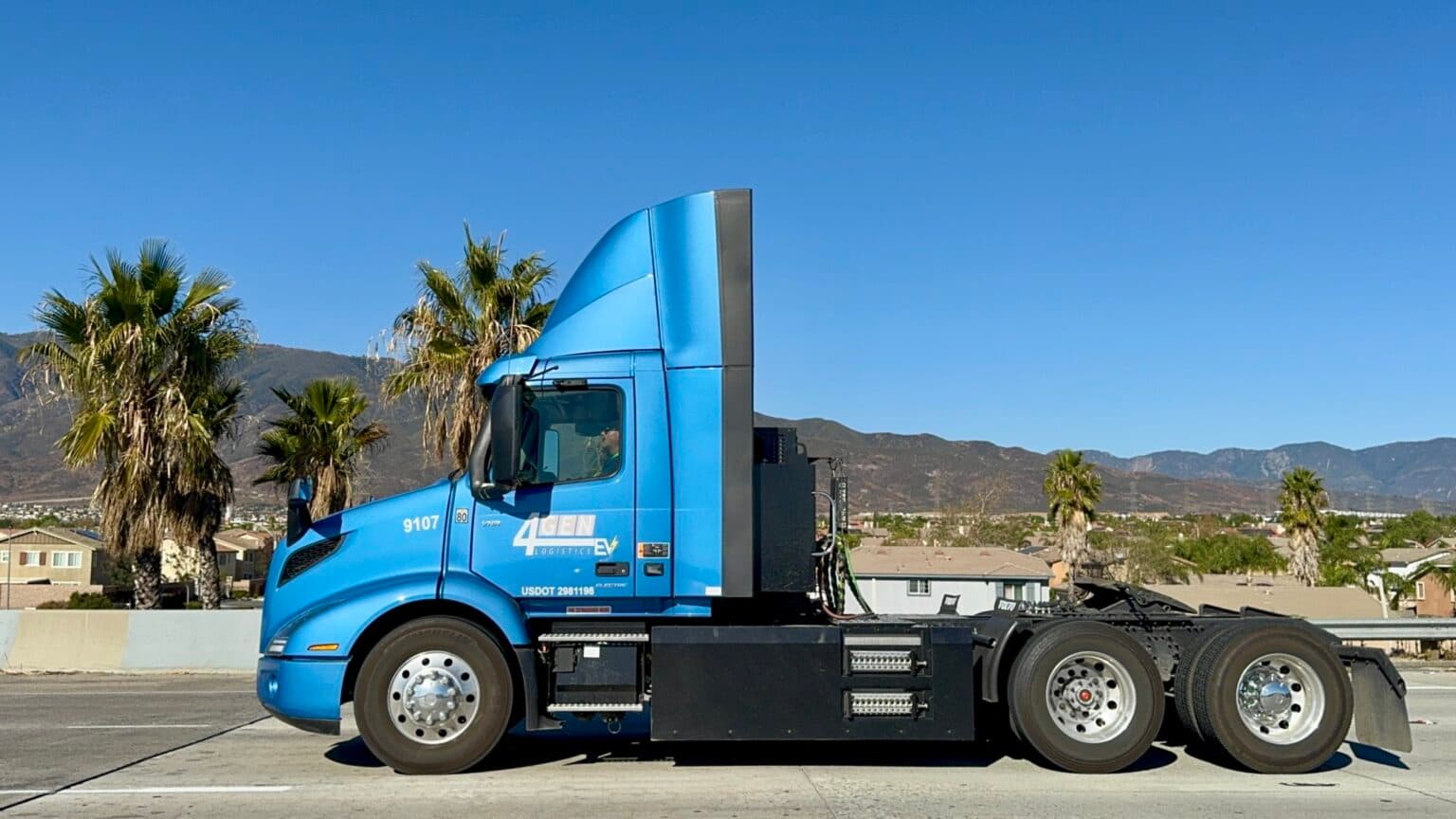

Geotab's 2026 State of Commercial Transportation shows a clear North American electrification plateau: EV maturity in 2025 registered at 2.2% in Canada and 1.6% in the United States, compared with 10.8% in the United Kingdom and 8.0% across the European Union. Despite North America holding the majority of Geotab-connected devices and therefore the largest absolute number of connected EVs, growth momentum and operational maturity are lagging.
Regional snapshot: maturity vs momentum
The raw numbers tell two stories: North America has many connected EVs, but its fleets are not yet using them aggressively. Year-over-year EV growth in 2025 was:
| Region | EV maturity 2025 | YoY EV growth 2025 |
|---|---|---|
| Canada | 2.2% | +32.1% |
| United States | 1.6% | +27.4% |
| Mexico | 1.9% | +36.4% |
| European Union | 8.0% | >146% |
| United Kingdom | 10.8% | +76.5% |
Why maturity lags despite rising counts
Geotab labels the U.S. electric truck market as “volume without velocity”: lots of connected EVs, but fewer activations relative to internal-combustion-engine (ICE) units. The U.S. activation rate fell from 2.9% in 2024 to 1.6% in 2025, and for every EV added, fleets still added roughly 60 ICE vehicles. That’s a signal fleets are hedging bets rather than full-stepping into electrification.
Operational maturity: utilization and depth of discharge
Buying an electric vehicle is only the down payment; the real return rides on asset utilization. Globally, Geotab-connected EVs traveled more than 920 million miles in the last year but accounted for only 2% of total commercial mileage in its database, implying widespread underutilization.
- Depth of discharge (DoD): European fleets average about 48% daily DoD; U.S. fleets average 36%.
- Charging behavior: U.S. operators show a pattern of “panic charging” — 65% plug in when batteries are above 50% — which reduces productive running time.
- Infrastructure confidence: European fleets benefit from longer experience and denser public charging networks, increasing willingness to use larger percentages of battery capacity daily.
Range reality vs manufacturer claims
Real-world range is affected by speed, payload, terrain and weather; manufacturer figures are theoretical maxima. That gap matters to logistics planners because a 10–20% shortfall in expected range can break a planned dispatch or require an unplanned detour to charge, turning a smooth delivery into a messy reschedule.
When electrification makes sense — and when it’s already viable
For light commercial vehicles, Geotab estimates average lifetime TCO savings of about $1,900 per unit, with savings increasing as utilization rises. Battery degradation runs at only ~2.3% per year, supporting longer retention and condition-based replacement strategies.
Interestingly, heavy-duty applicability may be broader than many assume: an Altitude by Geotab study found that 53% of heavy-duty trucks never exceed 400 miles per day, and 56% of medium-duty vehicles stay under 250 miles — ranges attainable by many current battery systems. In plain language: a big chunk of daily heavy and medium duty routes are already within electric reach.
Practical implications for fleet managers
Translating these insights into operational change requires data-led workflows. Fleets must analyze duty cycles, charging windows, and route density to decide which vehicles to electrify first. Small victories — electrifying yard shuttle units or short-haul vans — can build confidence and justify charging investments, then scale to the trickier long-haul segments.
Report highlights at-a-glance
- Safety divide: U.S. collision rates dropped 18.4% YoY, but the riskiest 10% of drivers still cause 20% of collisions, signaling a need for predictive coaching.
- EV momentum gap: UK and Germany add EVs much faster (1 in 5 new vehicles) versus the U.S. (1 in 25).
- Fleet refresh wave: Pandemic-era additions now drive a 2025 retirement surge; assets can sit idle up to 49% of the year.
- AI adoption: GenAI is moving beyond reporting to real-time conversational data insights for predictive maintenance and operational resilience.
There’s a story behind every chart: fleets that treat EVs as a checkbox will see slow returns, while those that pair electrification with route redesign, charging strategy and data-driven maintenance will unlock the promised TCO gains. Call it the difference between owning a tool and knowing how to use it — you’d be surprised how often fleets forget the latter.
Provide a short forecast on how this news could impact the global logistics. If it's insignificant globally, please mention that. However, highlight that it's still relevant to us, as GetTransport.com aims to stay abreast of all developments and keep pace with the changing world. Start planning your next delivery and secure your cargo with GetTransport.com. Book now GetTransport.com.com
Key takeaways are clear: electrification is technologically feasible for many commercial routes, but operational readiness — charging availability, utilization rates, and data-driven fleet management — is the gating factor. Even the most detailed reviews and honest feedback can’t replace riding in the cab for a week: personal experience reveals the quirks that datasets miss. On GetTransport.com, you can order your cargo transportation at the best prices globally at reasonable prices. This empowers you to make practical decisions without expensive missteps or disappointment. Benefit from the platform’s transparency, convenience and broad transport options to plan your next move, whether it's a housemove, pallet shipment, vehicle haulage or bulky freight — Book now GetTransport.com.com
In summary, Geotab’s 2026 findings show a contrast between connected EV counts and the actual operational use of those assets. For logistics teams weighing electrification, the path forward combines route analytics, conservative charging policies that evolve into confidence, and condition-based battery management to extract TCO benefits. Whether you’re planning a local delivery, international freight, bulky haulage or a full fleet refresh, aligning dispatch, charging and utilization is the quickest route to cost-effective electrification. Platforms like GetTransport.com provide an affordable, global way to secure transport for office or home moves, freight deliveries, vehicle shipments and bulky goods, helping fleets and shippers bridge the gap between intent and operational reality in transport and logistics.