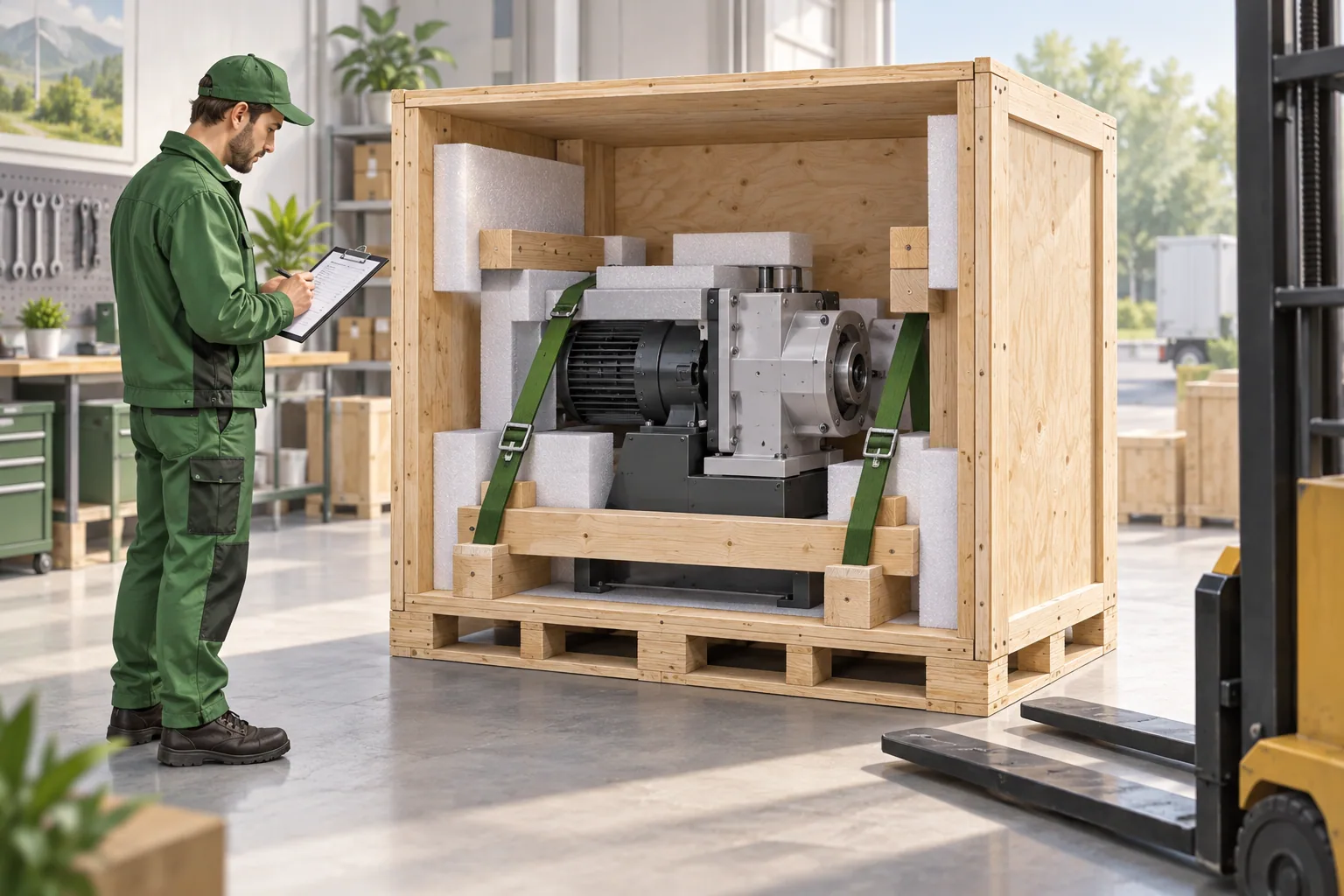
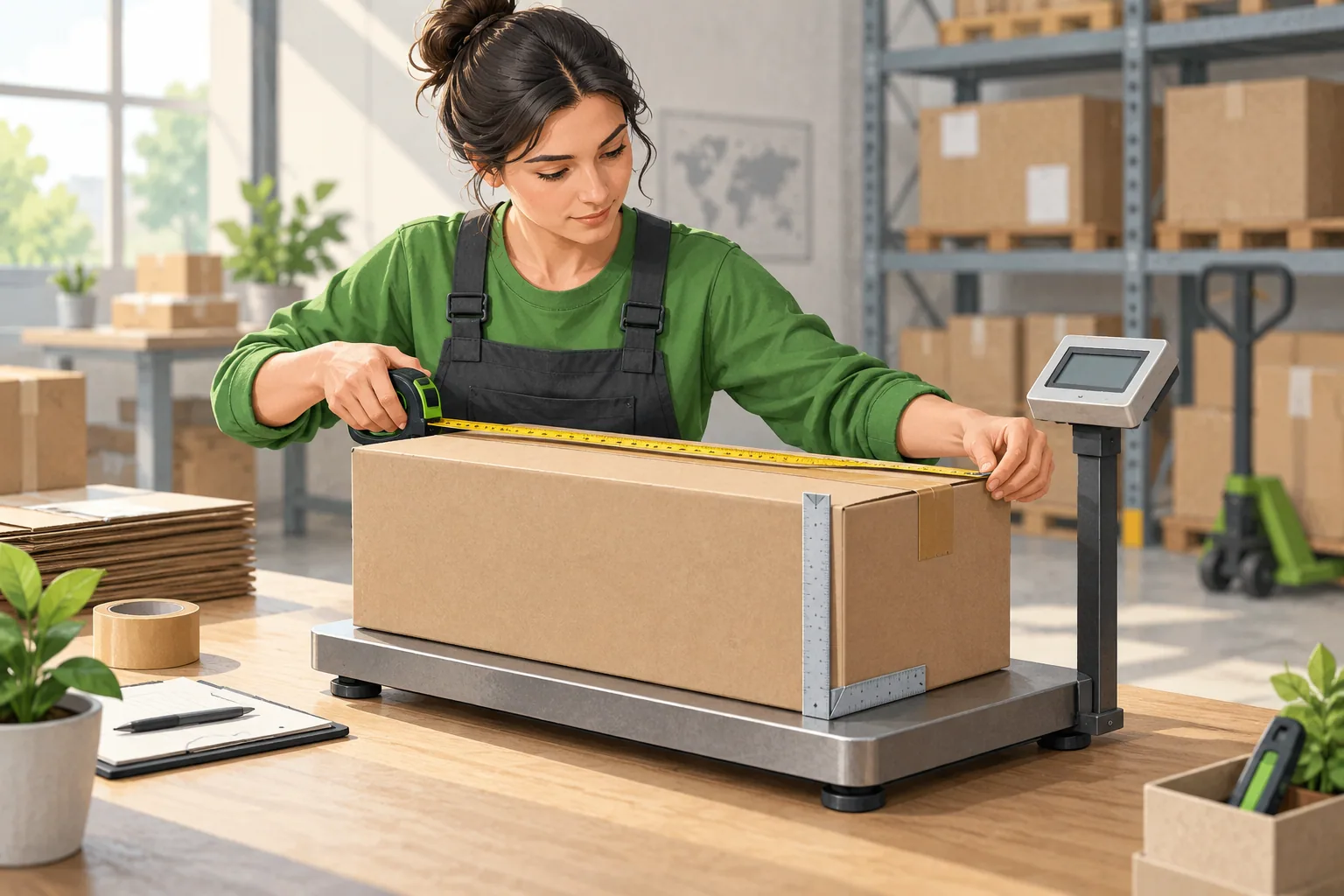
Record the package the carrier will collect
Measure each unit after packing. Include its pallet, crate, wrapping and anything that sticks out. Write the units beside every measurement, give each package an ID, and keep its gross weight separate from the shipment total. This gives you a record you can send with the same request to each carrier.
Take the measurements in this order
- Label the unit: A, B or another ID that also appears in your photos and inventory.
- Length and width: measure the outermost points in the intended transport position, including handles, protective edges and any overhang. A pallet's nominal size does not describe goods projecting beyond it.
- Height: measure from the bottom of the pallet or base to the highest packed point. Include the pallet, rather than measuring only the goods above its deck.
- Gross weight: weigh the complete packed unit using equipment suitable for it. Record the reading, unit and date. If the scale reading already includes the pallet and packing, do not add their weight again.
- Restrictions: state whether anything may be placed on top and note a required upright position or other handling instruction. Mark an unanswered stacking question as unknown.
- Check the final version: photograph the packed unit with its ID and a useful measurement reference. If the packing changes, update the measurements and tell the carrier.
For a heavy or awkward item, ask the packer or supplier to provide the measurements and transport position. Do not lift or rotate it just to complete this record.
Copy one record for each packed unit
- Unit ID and contents: [A; what is packed].
- Packed size: [length] × [width] × [height] [cm or another stated unit], including the base and projections.
- Gross weight: [value and unit]; [weighed on date / estimated, with basis].
- Stacking and position: [stackable / non-stackable / unknown]; [required position or restriction].
- Photo reference: [unit ID]; still to confirm: [missing measurement or handling detail].
After the individual records, add the number of units and total gross weight. Keep different units on separate lines; an average size can hide the largest item the carrier must handle.
Example: two pallets of different sizes
Illustrative shipment: the sizes and weights below are invented for this example.
- Pallet A: 120 × 80 × 110 cm packed; 220 kg gross, weighed; non-stackable.
- Pallet B: 120 × 100 × 90 cm packed; 180 kg gross, weighed; non-stackable.
- Shipment: 2 pallets; 400 kg total gross weight. Keep both sets of dimensions in the description.
The total weight is 220 + 180 = 400 kg. Do not replace these two unit records with one unexplained set of dimensions: the carrier needs to know what each packed unit is.
Calculate volume without mixing units
For a rectangular packed unit, multiply length × width × height in metres. If all three dimensions are in centimetres, divide their product by 1,000,000.
- Pallet A: 1.20 × 0.80 × 1.10 = 1.056 m³.
- Pallet B: 1.20 × 1.00 × 0.90 = 1.080 m³.
- Total: 1.056 + 1.080 = 2.136 m³.
Keep the 2.136 m³ total alongside the two unit records. It does not describe how the pallets can be arranged or establish the freight price. For an irregular object, the outer dimensions describe the space it needs, rather than the volume of material inside it.

What if you only know the goods' weight?
Net weight describes the goods without packaging; gross weight describes the complete packed unit. For example, 200 kg of goods plus a 20 kg pallet and packaging gives 220 kg gross. Use the actual figures for your shipment.
If you have only a supplier's net-weight figure, ask the packer for a gross-weight reading for each finished unit. If weighing is still pending, write that clearly, give the basis of any estimate, and ask whether the carrier can arrange measurement and what it costs. Do not enter zero to stand for an unknown weight.
Chargeable weight is the provider's billing measure. Ask how it treats actual weight, volume, occupied floor space, non-stackability and rounding. DHL Freight Sweden's terms provide a carrier-specific example of including packaging and loading accessories in measurements; their conversion factors are not a universal road-freight formula.
Put the record into your GetTransport request
The Truck form has a “Total cargo weight” field and one group of length, width and height fields. Put the full per-unit record in the shipment description, with units written explicitly, and label the shipment total separately. For the example above, the description lists A and B individually and states “2 pallets; total gross weight 400 kg”.
Use the units and instructions shown by the form. If they are unclear, keep your complete measurement record in the description and ask how to enter the numeric fields. Do not invent a rule for combining several units into the single dimensions group.
Prepare a Truck request with your measurement record. Use the shipment checklist for the handling, access and date details you still need.
Before accepting an offer, ask the carrier to confirm that it covers these packed units and any estimates still awaiting measurement. If a finished unit changes, send the revised record and get confirmation of any change to handling or the full quoted price.
Sources and checks
Each date records a check of the stated claim and scope.
- Packaging and loading accessories are included in measurements; billing conversion depends on service.
DHL Freight Sweden; edition valid 2026-09-27; provider-specific example · Checked October 10, 2026
Ready for the next step?
Turn your shipment details into a clear request.
Prepare your cargo, access and timing details, then compare the scope of each carrier's offer.
Something has changed? Tell us what needs correcting.