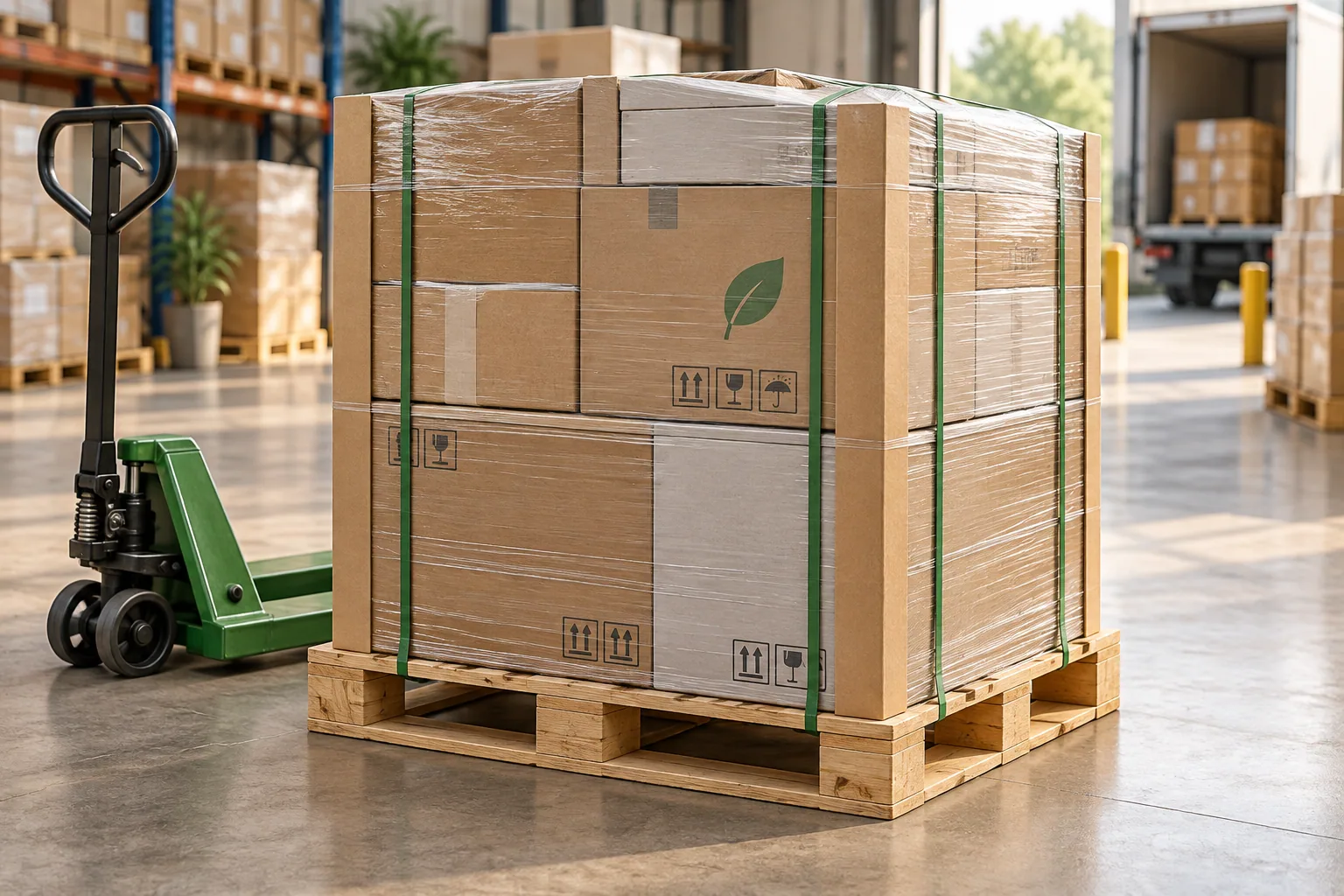
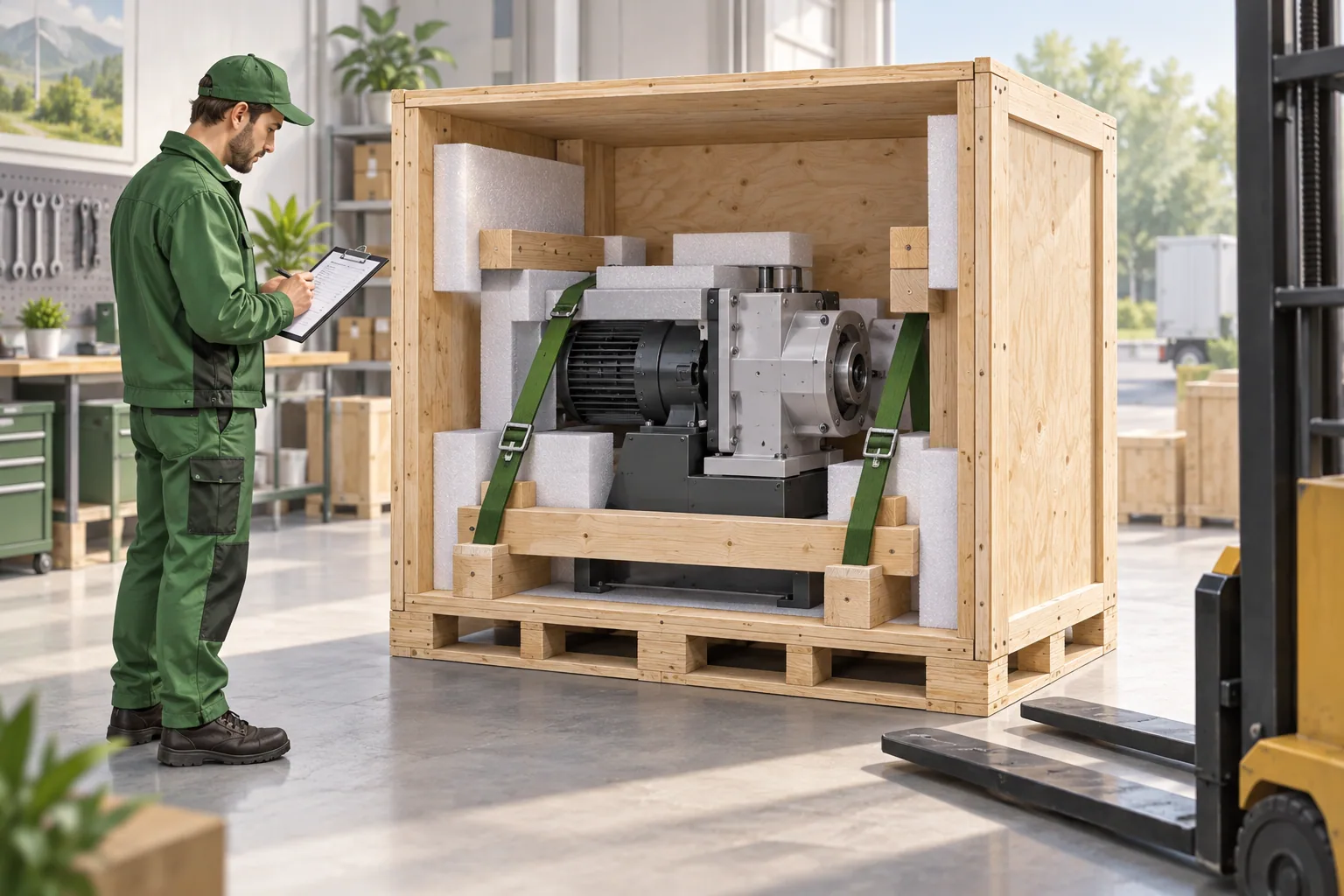
Use the completed transport brief first, then replace its unit figures and site arrangements with your own confirmed record.
Example: turn two packed pieces into one transport brief
Invented commercial planning example. A workshop is moving a machine from Lisbon to Coimbra. Its service specialist has supplied the preparation instructions and confirmed the finished packed figures below. The figures illustrate the request record; the specialist's instructions govern the actual machine preparation and handling.
| Unit | Packed size and gross weight |
|---|---|
| M1 — crated machine | 125 × 90 × 150 cm 360 kg gross |
| A1 — accessory case | 60 × 40 × 35 cm 25 kg gross |
The request says 2 packed units, 385 kg total gross, because 360 + 25 = 385 kg. It retains both sets of dimensions. The accessory case appears as its own piece to collect and check at delivery.
The sender's specialist handles isolation and the specified transport preparation. Collection and delivery are at ground-level loading bays. The sender's loading team is arranged; unloading still needs to be included in the carrier's proposal. A useful commercial brief is:
Copy the equipment record into your request
Please quote transport from our Lisbon loading bay to the Coimbra loading bay for M1 and A1, using the attached unit record: 2 units, 385 kg total gross. The specialist's transport instructions and preparation record are attached; M1 must travel in the specified position. The sender arranges loading. Include suitable unloading equipment and a competent operator at delivery, and identify any handling assessment your proposal requires. Quote the complete stated work and show any conditional amount separately.
For your own request, label the machine package and accessory case, photograph their condition and put those IDs beside their actual packed figures. Attach the relevant transport instructions. Share that same record with the specialist, packer, carrier and receiver. If the finished weight or instructions are missing, replace only that field with a named outstanding task; keep the rest of the brief usable.
Build a transport record from the machine’s instructions
A production machine is not just a heavy box. Obtain the maker’s instructions for the actual model and configuration. Ask the supplier or a competent specialist for missing information about shutdown, movement, transport position, support and recommissioning.
The EU Machinery Directive, Annex I 1.7.4.2(o)–(p), addresses stability and instructions for safe transport, handling and storage, including relevant mass information. This supports starting with the specific machine’s instructions; it does not establish that a particular machine or transport plan is compliant.
- Identity and instructions: Model, configuration, relevant manual/revision and a supplier contact
- Packed load: Final dimensions and gross weight; transport position, projections and anything still estimated
- Handling information: Manufacturer-verified lifting/handling points and relevant centre-of-gravity information; no guessed points
- Preparation: Who safely isolates/disconnects it, secures moving parts and fits any specified transport restraints
- Contents: Disclosed batteries, fuel, fluids, pressure systems or other potentially regulated contents; assessment still needed if unknown
- Both sites: Access, floor/route suitability, equipment, operators and agreed handover points
- Arrival: Who inspects, removes transport restraints and recommissions according to instructions
Keep detailed serial information in the handover record as needed; the initial commercial request need not expose unnecessary identifiers. Unknown weight, handling points or contents are open questions, not zeros or “none”.
Name who does each job
- Supplier or service specialist: confirms preparation, safe isolation/disconnection and the instructions for this machine. An off switch alone does not establish that all energy sources have been made safe.
- Packer: proposes suitable support and protection for the declared configuration and planned handling, including sensitive projections and separate accessories.
- Handling provider: confirms the loading and unloading method, equipment and competent people at both ends.
- Carrier: confirms vehicle, route, load securing and acceptance of the declared packing and contents.
- Receiver: confirms site readiness, inspection and the person responsible for recommissioning.
Agree the allocation for the actual contract; these are planning roles, not a declaration of everyone’s legal liability. One provider may perform several jobs. A price quote alone is not a lifting plan.
Do not turn generic packing advice into a lifting procedure
DHL Express’s 2026 large-piece guide gives provider-specific industrial-equipment packaging requirements. It is not a universal road-freight rule. Have the packer confirm an appropriate crate or base, stability and protection for your actual equipment. A crate also does not replace vehicle load securing.
UK HSE’s lifting guidance explains why planning needs suitable competence and should address the people, equipment and risks involved. It is a UK reference, not the law of Portugal or Spain. Arrange appropriate local specialist planning; do not improvise sling positions or rely on a single headline equipment capacity.
Disclose contents before booking
Tell the carrier about batteries, fuel, residual liquids, gases and pressure systems, including anything you cannot identify. Ask the supplier and appropriately qualified provider to assess the preparation and transport requirements. Do not apply a blanket “drain everything” or “disconnect the battery” instruction from another service to your machine. Any such work must follow the applicable technical instructions and arrangements.
Oversize, unusual weight or restricted cargo needs route-specific assessment. A domestic route alone does not establish that no authorisation or specialist handling is needed. Ask about declared value and insurance terms separately.
Keep evidence through handover
Keep condition photos, an accessory inventory, preparation confirmation and the accepted transport record. At arrival, inspect safely as agreed and report specific issues; let the responsible specialist remove transport restraints and restore operation. Use the request guide to share the commercial specification and the shipment checklist to track unresolved tasks.
Sources and checks
Each date records a check of the stated claim and scope.
- Annex I 1.7.4.2(o)–(p) concerns stability and safe transport/handling/storage instructions, including relevant masses.
EU machinery within Directive scope; not a certification of a specific machine or shipment · Checked October 10, 2026
- Industrial-equipment packaging guidance is specific to the DHL Express network.
DHL Express 2026 guide, printed pages 2 and 10; not universal road-freight or fluid-draining instructions · Checked October 10, 2026
- Planning lifting operations needs appropriate competence, resources and risk assessment.
UK HSE guidance, Planning section; used as a safety reference, not Portuguese or Spanish law · Checked October 10, 2026
Ready for the next step?
Turn your shipment details into a clear request.
Prepare your cargo, access and timing details, then compare the scope of each carrier's offer.
Something has changed? Tell us what needs correcting.