


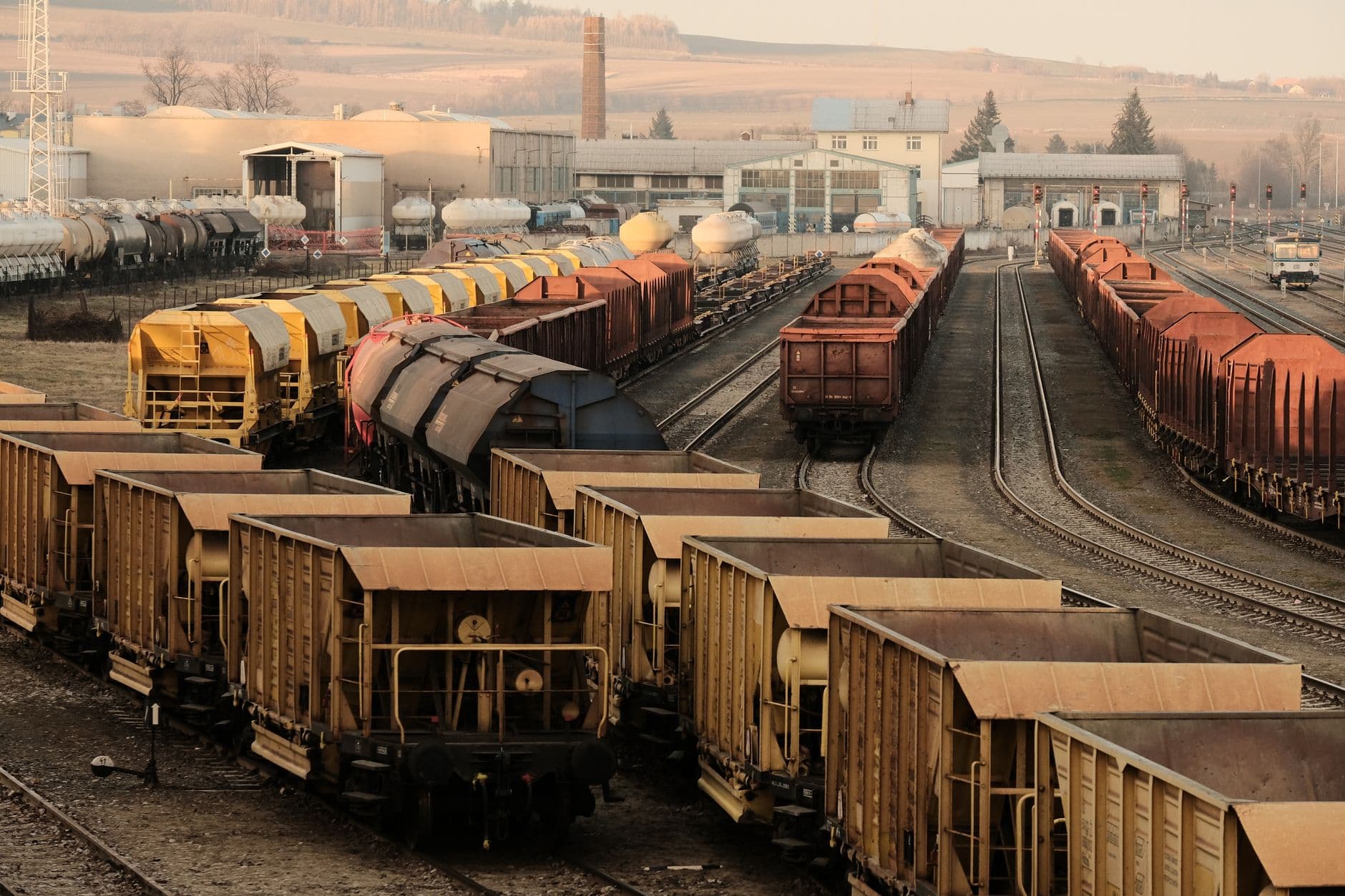

Union Pacific's Bailey Yard in North Platte, Nebraska is the largest rail classification yard in the world. It covers 2,850 acres, runs more than 13 kilometres end to end, and sorts about 14,000 rail cars every 24 hours across 17 receiving and 16 departure tracks, with roughly 139 trains passing through on an average day.
Those two numbers, acres and cars per day, do not track each other. A yard can be enormous and slow, or compact and relentless. I spend most of my time on air freight, and the first time I stood in front of a yard diagram I assumed the biggest facility moved the most freight. It does not work that way, and in North America the largest yards have been switched off and back on again for reasons that have nothing to do with their size.
The biggest rail yards in the world in 2026
| # | Yard | Location | Scale | Claim to fame |
|---|---|---|---|---|
| 1 | Bailey Yard | North Platte, United States | 2,850 acres, 13 km long, 3.2 km at its widest | Largest in the world, about 14,000 cars a day, 139 trains a day |
| 2 | Zhengzhou North | Zhengzhou, China | Over 6,000 m long, over 800 m wide | Largest in Asia, averages over 24,000 wagons a day |
| 3 | Maschen | Near Hamburg, Germany | 280 hectares, 7,000 m long, 700 m at its widest | Largest in Europe, second largest anywhere |
| 4 | Bekasovo | Moscow region, Russia | Multi-yard hump complex | Largest in Russia, sometimes claimed as Europe's largest |
| 5 | Deen Dayal Upadhyaya Junction | Mughalsarai, India | Long linear hump yard | Held the title of Asia's largest marshalling yard for decades |
| 6 | Clearing Yard | Chicago, United States | Belt Railway of Chicago's main hump | Core of the largest rail interchange in North America |
| 7 | Kijfhoek | Zwijndrecht, Netherlands | Compact hump yard | Sorts the Rotterdam port flows onto the European network |
| 8 | Enola Yard | Pennsylvania, United States | Historically vast, now much reduced | Once the largest yard in the world, hump long gone |
| 9 | Galesburg | Illinois, United States | Second largest hump on the BNSF system | Gaining a second hump lead track in 2026, about 300 more cars a day |
| 10 | Hallsberg | Sweden | Central Swedish hump yard | The sorting point for most Scandinavian wagonload traffic |
The pattern in that table changed direction recently. For most of the past decade the entries were losing humps, shrinking or arguing over disputed titles. Since 2026 the money has started flowing the other way, with concrete capacity projects at Avon and Galesburg, and to my mind that reversal is the most useful thing on the list.
What 14,000 cars a day actually means
Bailey Yard sorts cars by rolling them over a hump and letting gravity route each one into the correct bowl track. The yard receives inbound trains on 17 tracks, breaks them apart, and reassembles outbound trains on 16 tracks. Cargo passing through includes coal, grain, corn, sugar, chemicals, steel, finished automobiles, electronics and apparel, which is to say most of what moves across the American interior.
At 139 trains and 14,000 cars in 24 hours, the yard handles roughly one car every six seconds, continuously. The facility is 8 miles long, and North Platte built a public observation tower next to it because the operation is genuinely difficult to see any other way.
Compare that with Zhengzhou North, a bidirectional three-level, eight-yard layout that now averages more than 24,000 wagons a day. On that measure the Chinese yard is well past Bailey in routine throughput, even though Bailey holds the area title, and Zhengzhou North has become central to China-Europe freight train flows as those volumes have grown. Its historic single-day record of 31,464 wagons, set on 5 May 2003 along with 15,968 in one shift, is now closer to its daily work than it once was.
Three yards claim to be the largest on their continent
Titles in this field are messy, and the reason is that nobody agrees on the unit of measurement.
- Area favours Bailey Yard at 2,850 acres, which is 11.5 square kilometres and larger than many towns.
- Length favours linear yards. Zhengzhou North runs over 6,000 metres and Maschen 7,000 metres, so on that single measure the German yard leads the Chinese one while handling far fewer wagons.
- Throughput favours whichever yard is having a good year, and peak records survive in reference works long after the traffic that produced them has gone.
- Number of tracks or bowl capacity is the measure operators themselves use, and it is the one least often published.
That is why Mughalsarai in India carried the label of Asia's largest marshalling yard for decades while Zhengzhou North now holds it, and why both Maschen and Bekasovo get called Europe's largest depending on the source. When a client cites a yard's ranking to argue that a route has capacity, I ask which measure they mean, because the answer is often the one that flatters the argument.
The hump yards that were switched off, then switched back on
Between 2017 and 2021 North American railroads dismantled a large part of their sorting capacity on purpose. Under precision scheduled railroading, the operating theory held that sorting individual cars at big terminals wasted time, and that running longer trains on fixed schedules with less classification would cut dwell.
Norfolk Southern idled the humps at Allentown, Sheffield, Linwood and Bellevue, then Macon as the sixth since 2019, leaving four hump yards on its network: Elkhart and Conway in the north, Birmingham and Chattanooga in the south. CSX converted eight classification yards to flat switching in 2017.
Then some of it came back, and the reversal has kept going. CSX restored hump operations at Radnor Yard in Nashville and at Avon Yard near Indianapolis, both flat-switched under the same programme that shut them. In January 2026 CSX finished extending the hump lead at Avon, adding 200 to 300 cars a day of capacity. BNSF is spending on the same idea at Galesburg in Illinois, its second largest hump, where a second hump lead track is set to add roughly 300 cars a day.
A railroad that reopens a hump is admitting that the traffic it serves is genuinely mixed and cannot be handled as unit trains, whatever the operating model says. A railroad that then lengthens the hump lead is going further and betting capital on that admission, which is why I now treat hump investment news as a service quality signal for my clients' carload lanes.
For a shipper, that history is not trivia. It tells you that carload service quality on a given lane depends on decisions made about sorting capacity years earlier, and those decisions get reversed. If your commodity moves in single cars rather than full trainloads, the presence of a working hump on your route is a service quality signal worth checking.
Why Chicago matters more than any single yard
Chicago is the largest rail interchange in North America, and the constraint there has never been yard size. It is the handoff. Six major railroads meet in the region, and a car moving from a western carrier to an eastern one has to be physically transferred between different companies' networks, sometimes by a short-line switching railroad.
Clearing Yard and the Belt Railway exist to make those transfers work. When people say a container took four days to cross Chicago, the delay was not sorting. It was waiting for an interchange window between two carriers with different priorities. Building a bigger yard does not fix an interchange problem, which is why the largest yard in the world sits in Nebraska rather than in the city that actually needs the capacity.
Frequently asked questions
What is the largest rail yard in the world?
Bailey Yard in North Platte, Nebraska, operated by Union Pacific. It covers 2,850 acres, extends more than 13 kilometres, and handles about 14,000 rail cars and 139 trains in a typical 24 hour period.
What is the largest rail yard in Europe?
Maschen, just south of Hamburg, at 280 hectares and 7,000 metres long, with a maximum width of 700 metres. It is generally described as the second largest yard in the world after Bailey Yard, though Bekasovo in Russia is sometimes given the European title instead.
What is a hump yard?
A classification yard where cars are pushed over a raised section of track and released, so gravity rolls each car into an assigned bowl track where its outbound train is being assembled. Retarders slow the cars. The alternative, flat switching, uses locomotives to shove cars into position and is slower per car but cheaper to run.
Why did American railroads close their hump yards?
Precision scheduled railroading favoured long scheduled trains with minimal terminal sorting. Norfolk Southern idled six humps from 2019 onward and CSX converted eight yards to flat switching in 2017. The industry has since partly reversed: CSX restored humps at Radnor and Avon, extended the Avon hump lead in January 2026 for 200 to 300 more cars a day, and BNSF is adding a second hump lead at Galesburg for about 300 more.
Which yard handles the most wagons in one day?
Zhengzhou North in China, which averages over 24,000 wagons a day and holds a single-day record of 31,464 set on 5 May 2003, with 15,968 in one shift. Bailey Yard handles about 14,000 cars daily, so China leads on throughput while the United States leads on yard area.
Sources: Bailey Yard dimensions and throughput follow Union Pacific and North Platte published figures; the 2,850 acre area is also cited as 3,000 acres depending on whether adjacent facilities are counted. Zhengzhou North's daily average is per recent Chinese railway reporting, and its 2003 single-day record is historic. Maschen's dimensions come from Deutsche Bahn descriptions. Yard rankings depend heavily on whether area, length, track count or throughput is used, and hump status changes with operating strategy. Verify current sorting capability on your specific lane with the carrier.