



Most shippers never choose a transhipment hub. They choose a carrier, a price, and a transit time, and the hub arrives as a line on the routing that nobody reads. Then a connection is missed at a port they had not thought about, a container sits for 11 days waiting for the next feeder, and the conversation about hubs finally happens, several weeks too late.
The eastern Mediterranean is a good place to have that conversation early, because the capacity picture there changed materially this year. A new transhipment terminal at Damietta in Egypt came into commercial operation in February 2026, adding a large block of capacity close to the Suez axis at the same time as carriers are weighing whether to bring services back through the canal. Both of those things move at once, and hub loading can shift faster than anything else in a network.
What opened at Damietta
Damietta Alliance Container Terminals began commercial operations in February 2026, with Hapag-Lloyd's Essen Express making the inaugural call on 14 February. Hapag-Lloyd The facility represents roughly $600 million of investment and is designed for annual throughput of about 3.3 million TEU.
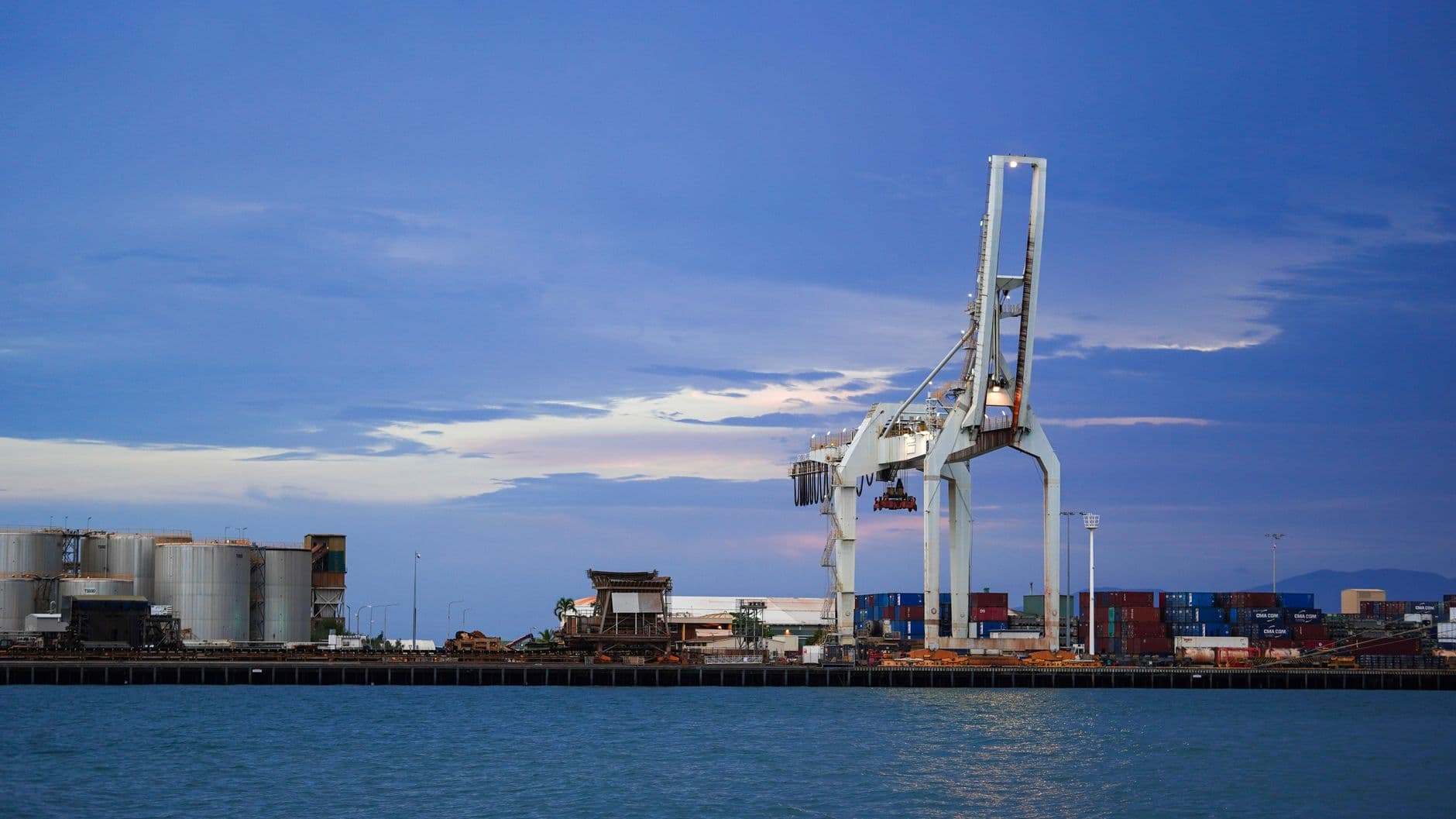
The physical specification is what tells you which ships it can serve. The terminal covers about 93 hectares with a quay of 1,670 m and water depth of 18 m, equipped with 12 electric ship-to-shore cranes with 25-row outreach and 40 hybrid rubber-tyred gantries.
Three of those numbers decide whether a terminal is relevant to a mainline service. Depth of 18 m accommodates the largest container vessels in service. A 25-row crane outreach means the cranes can physically reach across the widest hulls, which is a constraint that quietly disqualifies otherwise capable terminals. And a quay of 1,670 m allows more than one large vessel alongside simultaneously, which is the difference between a berth window and a queue.
The design split is the detail I would flag to anyone evaluating it: the terminal is built for roughly 80% transhipment and 20% local cargo. That is a deliberate choice with consequences in both directions, and it is worth understanding before you route cargo through it.
One naming point, because it causes confusion in booking conversations. Damietta has more than one container facility, and figures circulating for a quay of 1,970 m and capacity of 3.5 million TEU belong to a different terminal at the same port. The joint-venture facility discussed here is DACT, and if you are asking a carrier which terminal your box will be relayed across, use the terminal name rather than the port name.
Why a transhipment-first terminal behaves differently
A gateway terminal serves an economy. Its berths, yard, and gate are sized around local import and export flows, and transhipment is incremental business that gets whatever capacity is left. A transhipment-first terminal serves networks, and the difference shows up in the things that actually affect your box.
The advantages are real. Yard planning is built around ship-to-ship connections rather than around trucks, so dwell is measured in connection windows rather than in customs clearance and inland collection. There is no landside congestion dragging on berth productivity, because there is comparatively little landside. And the terminal's commercial interest is aligned with keeping connections rather than with prioritising local shippers when things get tight.
The exposure is equally real, and it is concentration. A hub with 80% transhipment has no captive cargo base to fall back on. If a carrier alliance restructures a service and moves its relay elsewhere, volume can leave quickly, and the same flexibility that fills a hub in one year can empty it in the next. I have watched more than one Mediterranean hub go from congested to quiet inside 18 months on the strength of network decisions made in a headquarters somewhere else.
East or west, and what deviation costs
Mediterranean transhipment splits into two distinct propositions and the choice is mostly geographic.
Western hubs, meaning the Algeciras, Tanger Med, and Valencia cluster around the Strait of Gibraltar, sit where Atlantic, North European, and Mediterranean flows meet. They serve cargo whose second leg goes north or west, and they have deep carrier commitment and long-established feeder networks. The scale gap is wide and getting wider: Tanger Med handled 11,106,164 TEU in 2025, up 8.4% on the year, and accounts for more than 47% of all container traffic across the five ports in the Gibraltar cluster. WorldCargo News
| Hub | Basin | 2025 throughput | Second leg it serves best |
|---|---|---|---|
| Tanger Med | Gibraltar | 11.1m TEU | North Europe, West Africa, Atlantic |
| Valencia | West Med | ~5.6m TEU | Iberia, West Med |
| Piraeus | East Med | ~5.1m TEU | Adriatic, Black Sea, Balkans |
| Algeciras | Gibraltar | 4.74m TEU | North Europe, Atlantic |
| Damietta (DACT) | East Med | 3.3m TEU capacity | Levant, Black Sea, East Africa |
Note that the Damietta figure is nameplate capacity rather than achieved volume, since the terminal has been running commercially only since February. Comparing a design capacity against four ports' actual throughput flatters the newcomer, and I would treat its first full year as the real test.
Eastern hubs, Damietta and Port Said among them, sit close to the Suez approaches. Their advantage is deviation: a mainline vessel transiting the canal can call with minimal detour from the route it was already sailing, which keeps the relay cheap in both time and fuel. For cargo whose second leg goes into the Levant, the Black Sea, the Adriatic, or East Africa, an eastern hub is usually the shorter total path even when the sea distance looks similar on a chart.
Egypt has been adding capacity on both sides of the canal mouth. APM Terminals expanded the Suez Canal Container Terminal at Port Said, adding around 2.2 million TEU of annual capacity, and Damietta's 3.3 million TEU arrives on the Mediterranean coast west of the canal entrance. That is a substantial concentration of relay capability in one country, and it is not accidental.
The trade-off to weigh honestly is exposure. An eastern Mediterranean hub is close to the Suez corridor, which is its whole commercial logic and also its risk, since disruption in the Red Sea affects the mainline services that feed it. Western hubs are insulated from that but pay for it in deviation on Asia-bound flows. If you want the full framework for the routing decision underneath this, we set it out in the guide to Suez and Red Sea routing in 2026. Hub choice sits downstream of that decision and should not be made independently of it.
The congestion risk that comes with recovery
There is an irony in the timing worth naming. New Mediterranean capacity is arriving precisely when services might return to the Suez routing in volume, and the return is the thing that would strain the region rather than relieve it.
The mechanism is worth following. While mainline services route around the Cape of Good Hope, Mediterranean transhipment demand is suppressed, because Asia-Europe strings that avoid the canal have less reason to relay in the eastern basin. If services come back through the canal, eastern Mediterranean hubs regain relay volume quickly, and they regain it in a lumpy way, since alliance network changes take effect on a service date rather than gradually. Terminals that looked comfortably resourced can find themselves handling a step change in a single month.
The current numbers say the return has not happened yet, whatever the announcements suggest. Some larger vessels have gone back through the canal, but container transits in early 2026 were still down year on year, and January 2026 was the weakest January for canal traffic in a decade. That is the context for reading any carrier statement about resuming Suez routings: a handful of ships is not a network decision, and the hub loading that follows a real return has not arrived. Damietta is therefore opening into a suppressed market, with the step change ahead of it rather than behind.
So the new capacity at Damietta is better understood as arriving just in time than as arriving into a glut. For a shipper the practical read is that eastern Mediterranean transit reliability is likely to be more volatile over the next several quarters than the published schedules imply, in either direction, and a routing that depends on a tight connection there deserves a buffer.
What transhipment actually costs you
The price difference between a direct service and a relayed one is usually small, and it is not where the cost lives. In the moves I have priced over the past few years, the relay itself has added somewhere between 4 and 9 days to end-to-end transit when everything worked, and a missed connection has added a further week or more depending on feeder frequency on the second leg.
Three effects are worth pricing deliberately.
- Variance, not average. A relayed routing has more failure points than a direct one, so its transit distribution has a longer tail. If your inventory policy is set by worst-case arrival rather than by mean arrival, that tail is your real cost.
- Extra handling events. Each additional lift is an opportunity for damage and for a documentation mismatch, and cargo insurance treats handling events as risk exposures rather than as neutral logistics steps.
- Storage exposure at the hub. A container waiting for a delayed connection accrues time somewhere, and whether that time is free depends on the contract rather than on whose fault the delay was.
Questions I would put to a carrier
Hub choice is generally the carrier's to make, but the terms around it are negotiable and most shippers never ask. The questions that have changed outcomes for clients of mine are these.
- Which hub, and is it fixed? Ask for the named transhipment port in the routing, and ask whether the carrier may change it during the contract without notice. The answer is often yes, which is useful to know before rather than after.
- What is the guaranteed connection window? A service pair with a 2-day buffer at the hub behaves very differently from one with 12 hours, and the difference does not appear in the quoted transit time.
- Who pays when the connection is missed? Establish in advance whether storage at the hub during a carrier-caused delay is free time or a charge to you.
- Is the whole movement on one bill of lading? Through-carriage on a single document keeps liability with one party across the relay. Two documents can leave the gap between legs as your problem.
- What is the feeder frequency on the second leg? This single number determines the cost of a missed connection. Weekly feeders make a missed connection expensive; several sailings a week make it a nuisance.
For the wider view of which ports and operators sit behind these networks, our rankings of the busiest container ports and the largest terminal operators show who actually controls the quay you will be relaying across, and the survey of container ships and shipping lines covers the vessel sizes that dictate which terminals can serve a mainline call at all.
How I would use this
If your cargo moves between Asia and the eastern Mediterranean, the Levant, the Black Sea, or East Africa, the new Egyptian capacity is genuinely useful and worth asking your carrier about by name, because a relay with minimal deviation from the canal axis is the cheapest kind of transhipment there is.
If your second leg goes to northern Europe, the western hubs remain the natural choice, and Damietta's opening does not change that.
And whichever basin you use, treat the next few quarters in the eastern Mediterranean as a period of shifting loads rather than settled ones. Capacity is arriving, canal transits may recover, and alliance networks are being redrawn against both. That combination produces good service and occasional sharp congestion in the same region within the same year, which argues for a buffer on any connection you cannot afford to miss and for a routing you have actually read.
Terminal specifications and capacity figures are as reported by the operators and industry press in 2026. Service patterns and hub assignments change with carrier network decisions and should be confirmed against your current routing.