



When a shipper asks our freight desk how to move boxes from China to Europe without crossing Russia, the conversation almost always lands inside Kazakhstan. The country is the long eastern leg of the Middle Corridor, the stretch where cargo travels furthest by rail before it ever reaches the Caspian. For years that leg was the part we quoted with a caveat, because the track was congested and the routing inside Kazakhstan was longer than the map suggested. A financing decision taken in February 2026 starts to change that, and it changes it in ways a cargo owner can actually use.
GetTransport.com has matched carriers on Trans-Caspian lanes since before the corridor was crowded, so what follows is the operational read on Kazakhstan's rail overhaul, not the development-bank version. The headline is a new line and a large guarantee. The thing a shipper needs is what the new line does to capacity, to transit time and to the kind of container you can put on a train. That is what this guide covers.
What the World Bank actually approved
On 19 February 2026 the World Bank's Board of Executive Directors approved an $846 million IBRD guarantee to help Kazakhstan Temir Zholy, the national railway operator usually shortened to KTZ, raise $1.41 billion in long-term commercial financing. The Asian Infrastructure Investment Bank added a co-guarantee of $564 million on the same package. The formal name is the Transforming Rail Connectivity in Kazakhstan project, and the structure matters as much as the number.
This is a guarantee, not a grant. The World Bank is not writing KTZ a cheque. It is standing behind commercial lenders so that KTZ can borrow long money on terms it could not reach alone, which is why the $846 million guarantee mobilises roughly $1.41 billion of actual financing. For a shipper that distinction is more than accounting. It signals that the corridor is now being financed the way mature infrastructure gets financed, with private capital pulled in behind a sovereign-grade backstop, rather than waiting on the state budget cycle. That is the kind of money that builds track on schedule.
The Mointy-Kyzylzhar line, and why a shortcut matters
The first thing the money builds is a new railway. The project finances a greenfield line of 322.3 kilometres between Mointy and Kyzylzhar in central Kazakhstan. Greenfield means built on a fresh alignment rather than patched onto old track, and that is the point of it.
Today, traffic running east to west across Kazakhstan, from the China-facing gateways at Dostyk and Khorgos toward the Caspian ports at Aktau and Kuryk, takes a detour through this part of the network. The new line cuts straight through, and the World Bank states it shortens the corridor by 149 kilometres. On a single train that distance is minor. On a programme of block trains running week after week, 149 fewer kilometres on every move is fuel, crew hours and wagon turnaround that compounds, and it is exactly the kind of saving a regular shipper feels in the rate rather than the brochure.
The line is also being built with modern signalling and telecommunications, with design provisions for later electrification. That is the unglamorous part that decides how many trains the track can actually hold, because a corridor's real capacity is set by its signalling as much as by its rails.
Double-stack is the part that changes the lane math
Here is the detail our desk circles when a client asks what the overhaul really unlocks. The Mointy-Kyzylzhar line is being built to enable double-stack container operations, which means two containers stacked one above the other on a single wagon rather than one.
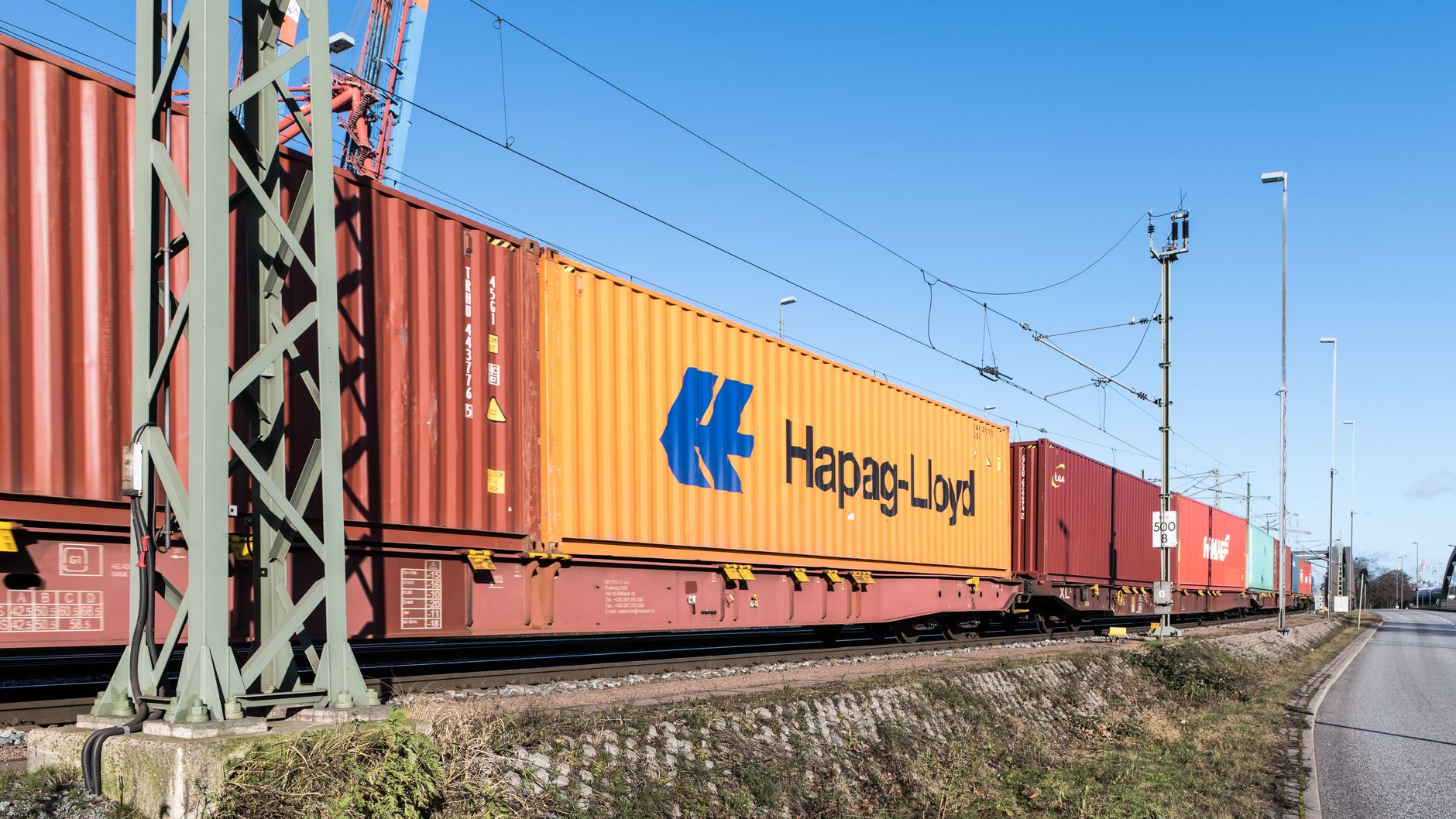
Double-stacking is the closest thing rail has to a free capacity upgrade. The same locomotive, the same crew and the same path through the network move roughly twice the boxes. On a corridor whose problem has been congestion rather than demand, that is the lever that actually loosens the chokepoint. It also bends the economics, because the cost of running the train is spread over more cargo, and rail on this routing competes with sea freight on price as much as on time. A shipper will not order a double-stack train directly, but the effect shows up where it matters, in more available capacity and steadier rates on a lane that used to sell out.
The transit-time story, honestly told
The number that gets a shipper's attention is transit time, and this is where the corridor has genuinely moved. Through the work of the joint venture set up by Kazakhstan, Azerbaijan and Georgia, transit on the Trans-Caspian route has come down from a historic 38 to 53 days to roughly 18 to 23 days, with the operating company targeting further cuts toward 18 days and eventually a 10 to 15 day band.
We quote those figures with a caveat, because a transit time on a multi-border corridor is a range, not a promise. The Caspian ferry leg and border dwell can still add an unplanned week, which is why we tell clients to read this together with our guide to crossing the Caspian in 2026. What the Mointy-Kyzylzhar line and the wider overhaul do is attack the part of the range that infrastructure controls. The World Bank's stated aim for the project is to triple freight volumes and halve end-to-end transit times on Kazakhstan's Middle Corridor segment by 2030. That is the trajectory, not a number you can book today, and we are careful to keep the two apart on a quote.
This is one piece of a much larger rebuild
The Mointy-Kyzylzhar line is the flagship, but it sits inside a national programme. Kazakhstan's main rail network runs to about 16,000 kilometres, and the government has put a wide modernisation effort against it, including 124 railway stations under renovation, with the headline works targeted for completion by 2029. KTZ has reported that more than 4,400 kilometres of track had been worked on by the end of 2025, including 1,575 kilometres in 2025 alone.
Why a freight desk cares about station and track works is simple. A corridor is only as fast as its slowest segment, and a brand-new shortcut feeding into worn track elsewhere just moves the bottleneck rather than removing it. Doing the new line and the network rehabilitation together is what makes the corridor's transit promise credible instead of a single fast stretch surrounded by congestion.
The demand is already there
None of this is being built ahead of traffic. The corridor is growing now, and the upgrades are chasing demand rather than hoping to create it. Container transit through Kazakhstan on the Middle Corridor grew about 15 percent in 2025, reaching 36,000 TEU, which was 4,700 boxes more than the year before. Rail freight between Kazakhstan and Uzbekistan, a key feeder market, rose about 16 percent to 32.3 million tonnes between 2024 and 2025.
That growth is also the reason the overhaul is urgent rather than optional. KTZ has described the existing network as operating near the limit of its capacity, with infrastructure wear running high, and a corridor that is already full cannot absorb the volumes everyone is forecasting without exactly the kind of new line and double-stack capability this financing pays for. For a shipper the read is that capacity on this lane has been tight, which is precisely why locking in space and a reliable carrier matters more here than on a lane with slack.
What it means for a cargo owner routing China to Europe
Pull the threads together and the practical picture for a shipper is this. The Kazakhstan leg of the Middle Corridor is being widened, shortened and made denser at the same time, with private money behind it and demand already pushing on the door. The corridor still asks for patience, because the Caspian crossing and the gauge changes at either end remain real steps, and the western exit through the Caucasus has its own constraints that we cover in our look at the Baku-Tbilisi-Kars line reaching full capacity.
What changes is the confidence with which we can quote it. A lane that we used to hedge on capacity is becoming one we can book as a programme, and a transit that lived in the five-to-seven week range is settling into the three-week band on a good run. None of that lands the day a guarantee is signed. The financing closed in February 2026, the line takes years to build, and the 2030 targets are exactly that. But the direction is now funded, and a marketplace view of who is running this corridor this month is what turns a 322 kilometre shortcut on a press release into space on a real train.
A planning note for Middle Corridor moves
- Treat the corridor as a chain, not a single line. The Kazakhstan rail leg, the Caspian ferry and the Caucasus exit each have their own constraints, and a plan that nails one and ignores the others still slips.
- Do not book to the best-case transit time. Quote the 18 to 23 day range with border dwell and Caspian queue built in, and treat the 2030 halving target as a trend rather than a deliverable.
- Lock space early on container traffic. Capacity has been the corridor's binding constraint, and the double-stack upgrades will take time to feed through to availability.
- Choose a carrier who already runs the full corridor and holds the ferry and gauge-change slots, rather than assembling the legs separately.
- Watch the build progress, not just the announcement. The lane math improves as track and stations come online through 2029, not the moment the financing is approved.
Frequently asked questions
What did the World Bank approve for Kazakhstan's railways in 2026?
On 19 February 2026 the World Bank Board approved an $846 million IBRD guarantee to help Kazakhstan Temir Zholy (KTZ) mobilise $1.41 billion in long-term commercial financing, under the Transforming Rail Connectivity in Kazakhstan project. The Asian Infrastructure Investment Bank added a $564 million co-guarantee. It is a guarantee that pulls in private capital rather than a direct grant, and its main physical output is a new line in central Kazakhstan plus institutional reform at KTZ.
What is the Mointy-Kyzylzhar line and why does it matter for shippers?
It is a new greenfield railway of 322.3 kilometres between Mointy and Kyzylzhar in central Kazakhstan. The World Bank says it removes a major network detour and shortens the corridor by 149 kilometres, eases congestion on heavily used sections, and enables double-stack container operations. For a cargo owner that means more capacity and better economics on the China-facing rail leg of the Middle Corridor, because double-stacking roughly doubles the boxes a single train can carry.
How long does China to Europe transit take via the Middle Corridor now?
Transit on the Trans-Caspian route has fallen from a historic 38 to 53 days to roughly 18 to 23 days, and the joint operating company is targeting further cuts toward 18 days and eventually a 10 to 15 day band. Treat these as a range, not a guarantee, because the Caspian ferry leg and border dwell still add variability. The World Bank's stated aim is to halve end-to-end transit times on Kazakhstan's Middle Corridor segment by 2030.
Is the Middle Corridor through Kazakhstan worth it for my cargo?
It is worth it when avoiding Russian transit is a requirement, when the cargo suits rail and short-sea, and when a transit measured in weeks rather than days is acceptable. Demand is already strong, with container transit through Kazakhstan up about 15 percent in 2025 to 36,000 TEU, so capacity is tight and early booking helps. It is a weaker fit for a single time-critical shipment, because the multi-border chain and the Caspian crossing add variability a hard deadline cannot always absorb.