


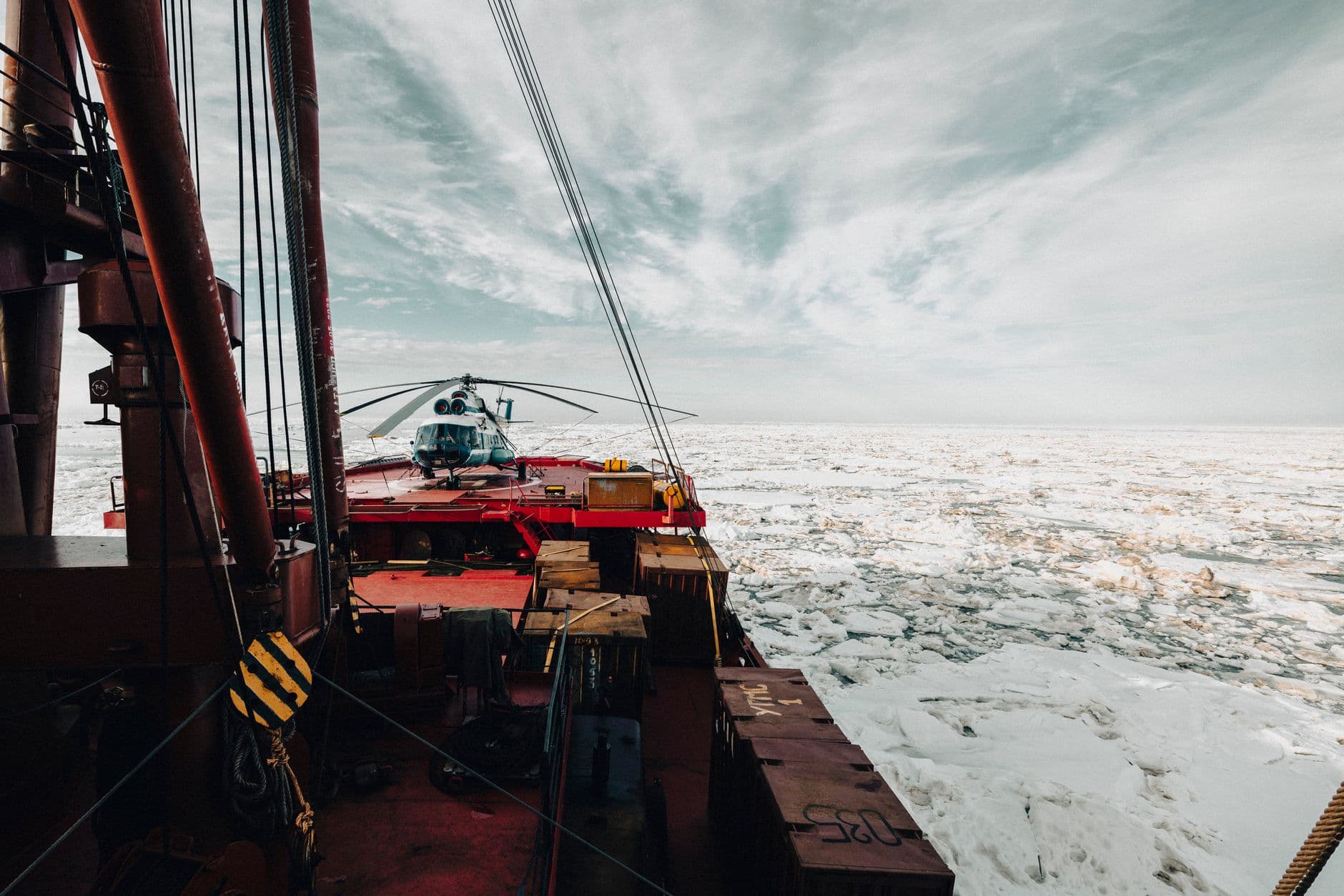
The most powerful icebreaker afloat belongs to the Russian Project 22220 class, rated at 60 MW. The most powerful one being built is Project 10510, named Rossiya, designed for 120 MW at the shafts from two RITM-400 reactors, displacing 69,700 tonnes and able to break ice up to 4 metres thick. It is due in 2030.
Meanwhile the route those ships exist to keep open moved less cargo in 2025 than in 2024, and less in 2024 than the year before. Icebreaker power and Arctic freight volume have been moving in opposite directions for two years, and that gap is the real story for anyone pricing a northern routing. Every Arctic business case I have been asked to check since 2024 has failed on the same line of the spreadsheet.
The most powerful icebreakers in the world in 2026
| # | Vessel or class | Operator | Power | Ice capability | Status |
|---|---|---|---|---|---|
| 1 | Rossiya, Project 10510 | Rosatomflot, Russia | 120 MW at the shafts, two RITM-400 reactors | Up to 4 m | Under construction at Zvezda, due 2030 |
| 2 | Arktika class, Project 22220 | Rosatomflot, Russia | 60 MW | Around 2.8 m | In service, Chukotka expected 2026 |
| 3 | 50 Let Pobedy | Rosatomflot, Russia | Around 54 MW | Around 2.8 m | In service, Arktika class predecessor |
| 4 | Polar Star | United States Coast Guard | Around 45 MW on diesel and gas turbines | Around 2 m ramming | In service, single heavy icebreaker |
| 5 | Xue Long 2 | China | Diesel electric, polar research class | 1.5 m at 2 to 3 knots | In service, first Chinese-built polar vessel |
| 6 | Polaris | Finland | LNG dual fuel | 1.8 m | In service, Baltic operations |
| 7 | Leningrad and Stalingrad | Rosatomflot, Russia | 60 MW each | Around 2.8 m | Project 22220 hulls due 2028 and 2030 |
| 8 | Polar Security Cutter | United States Coast Guard | Heavy class, diesel electric | Design target around 2 m | Programme delayed, first hull not delivered |
Russia operates eight nuclear icebreakers, a figure confirmed at the top of its government in January 2026, and deployed all eight simultaneously for the first time to keep Arctic export routes open. That is both a capability statement and a sign of how tight the margin is when everything has to sail at once.
What the extra megawatts buy
The number my clients fixate on is megawatts, and it is the wrong one to start with. The jump from 60 MW to 120 MW is not about speed. It is about breaking a 4 metre floe instead of a 2.8 metre one, and about the width of the channel left behind. Rossiya is designed to cut a lane wide enough for the large liquefied natural gas carriers that current escorts cannot comfortably lead, which is the actual commercial purpose behind the programme.
Year-round eastbound navigation is the stated goal. Today the practical season for commercial transits runs from roughly mid-July to late November, with the reliable window much narrower than that. A 120 MW escort would extend it, and the Russian government allocated about a billion dollars toward the vessel on that basis. Western sanctions against Rosatomflot have slowed construction across the programme, and the Project 22220 hulls have slipped repeatedly: Chukotka is expected in 2026, Leningrad in 2028 and Stalingrad in 2030, which would bring the class to seven ships.
The Northern Sea Route numbers, honestly
Total cargo on the Northern Sea Route reached 37.02 million tonnes in 2025, down 2.3 percent year on year and falling for the second consecutive year. That total is dominated by Russian domestic export flows, mostly hydrocarbons leaving Yamal and Gydan, rather than by anything transiting between Asia and Europe.
Transit cargo, which is what my clients mean when they ask about an Arctic alternative to Suez, set a record at 3.2 million tonnes. There were 103 full transits by 88 vessels, including 15 container ship transits. So the record and the decline are both true at once, and they describe different businesses. Transit is 8.6 percent of the route's traffic.
For scale, a single large container ship on the Asia to Europe trade can carry over 20,000 TEU, and the largest vessel in the new Arctic container fleet is 4,890 TEU. The route is not capacity-constrained by ice alone. It is constrained by the size of ship that can safely use it.
The first scheduled Arctic container service
Two developments moved Arctic container shipping from demonstration to timetable.
In 2025 the Istanbul Bridge, a China-linked container ship, left Ningbo on 22 September and arrived at Felixstowe on 13 October, the first liner service voyage to traverse the route. China recorded 14 Arctic container voyages that year, a record.
For 2026, Sea Legend Shipping launched China-Europe Arctic Express, the first regular weekly container service via the Northern Sea Route. Seven vessels ranging from 1,528 to 4,890 TEU are scheduled to run eight weekly departures from the Ningbo-Zhoushan complex between mid-August and early October 2026. The first sailing leaves Ningbo on 15 August 2026 and is due at Felixstowe around 5 September, which is roughly three weeks port to port.
I read those dates twice before believing them. Eight departures across seven weeks is the whole service. It is a seasonal shuttle inside a navigation window, not a replacement for a year-round string, and any supply chain built on it needs a Suez or Cape fallback for the other forty-five weeks.
Why the economics still do not close

- Ship size caps the unit economics. Ice-class hulls are heavier, more expensive and smaller. Running 4,890 TEU against 20,000 TEU competitors on a longer-tariff route erases most of the distance saving.
- The season is seven to fifteen weeks depending on how much risk an operator accepts, so assets need employment elsewhere for the rest of the year.
- Escort and permit costs are not published in comparable form. Northern Sea Route Administration permits, ice pilotage and escort fees vary with vessel class and season.
- Insurance and sanctions exposure deter most European and American shippers regardless of the freight economics, and Rosatomflot is itself under sanctions.
- Schedule integrity is unproven. Liner customers buy weekly reliability, and one bad ice year would strand a service with no alternative routing inside the same season.
- Ports along the route are thin. There is no meaningful intermediate cargo to pick up, so the ship sails a long leg for a single origin-destination pair.
Who else is building icebreakers
Finland has designed and built a large share of the world's icebreaking tonnage, and Finnish yards remain the reference point for conventional ice-class design. The trilateral icebreaker arrangement between the United States, Canada and Finland was set up to rebuild western capacity, since the United States Coast Guard operates a single functioning heavy icebreaker in Polar Star and its Polar Security Cutter programme has run years behind schedule.
China operates Xue Long 2, its first domestically built polar vessel, and has signalled further construction. None of these programmes changes the commercial picture we work with before 2030. The Arctic escort fleet that matters for cargo in 2026 is Russian, and the fleet expansion is aimed at Russian export volumes rather than at transit traffic.
Frequently asked questions
What is the most powerful icebreaker in the world?
In service, the Project 22220 Arktika class at 60 MW. Under construction, Project 10510 Rossiya at 120 MW from two RITM-400 reactors, displacing 69,700 tonnes and designed for ice up to 4 metres, with delivery targeted for 2030.
How much cargo moves on the Northern Sea Route?
37.02 million tonnes in 2025, down 2.3 percent and declining for a second year. Transit cargo hit a record 3.2 million tonnes across 103 full transits by 88 vessels, including 15 container ship transits.
Is there a regular container service through the Arctic?
Yes, seasonally. China-Europe Arctic Express runs seven vessels of 1,528 to 4,890 TEU with eight weekly departures from Ningbo-Zhoushan between mid-August and early October 2026. The first sails on 15 August 2026 and is due at Felixstowe around 5 September. Outside that window there is no scheduled service.
How much time does the Northern Sea Route save against Suez?
The Istanbul Bridge sailed Ningbo to Felixstowe between 22 September and 13 October 2025, about three weeks, against roughly 40 to 50 days for the same pair around the Cape of Good Hope during Red Sea diversions. The saving is real when the route is open and disappears entirely when it is not.
Do American or European operators use the route?
Very few. Sanctions on Rosatomflot, insurance limitations and reputational exposure keep most western shippers away, and the traffic that does move is overwhelmingly Russian export cargo plus a small number of China-linked container voyages.
Sources: icebreaker power ratings are according to builder and operator statements; Project 10510 has been described as both 120 MW at the shafts and 150 MW in political statements, and those figures measure different things. Delivery dates for Project 22220 hulls have moved repeatedly under sanctions pressure and should be treated as targets. Northern Sea Route cargo figures come from consultancy analysis of Russian administration data and are not independently audited. Service schedules for the 2026 Arctic container season are as announced by the operator and may change with ice conditions. Confirm permit, escort and insurance positions before planning cargo on this route.