


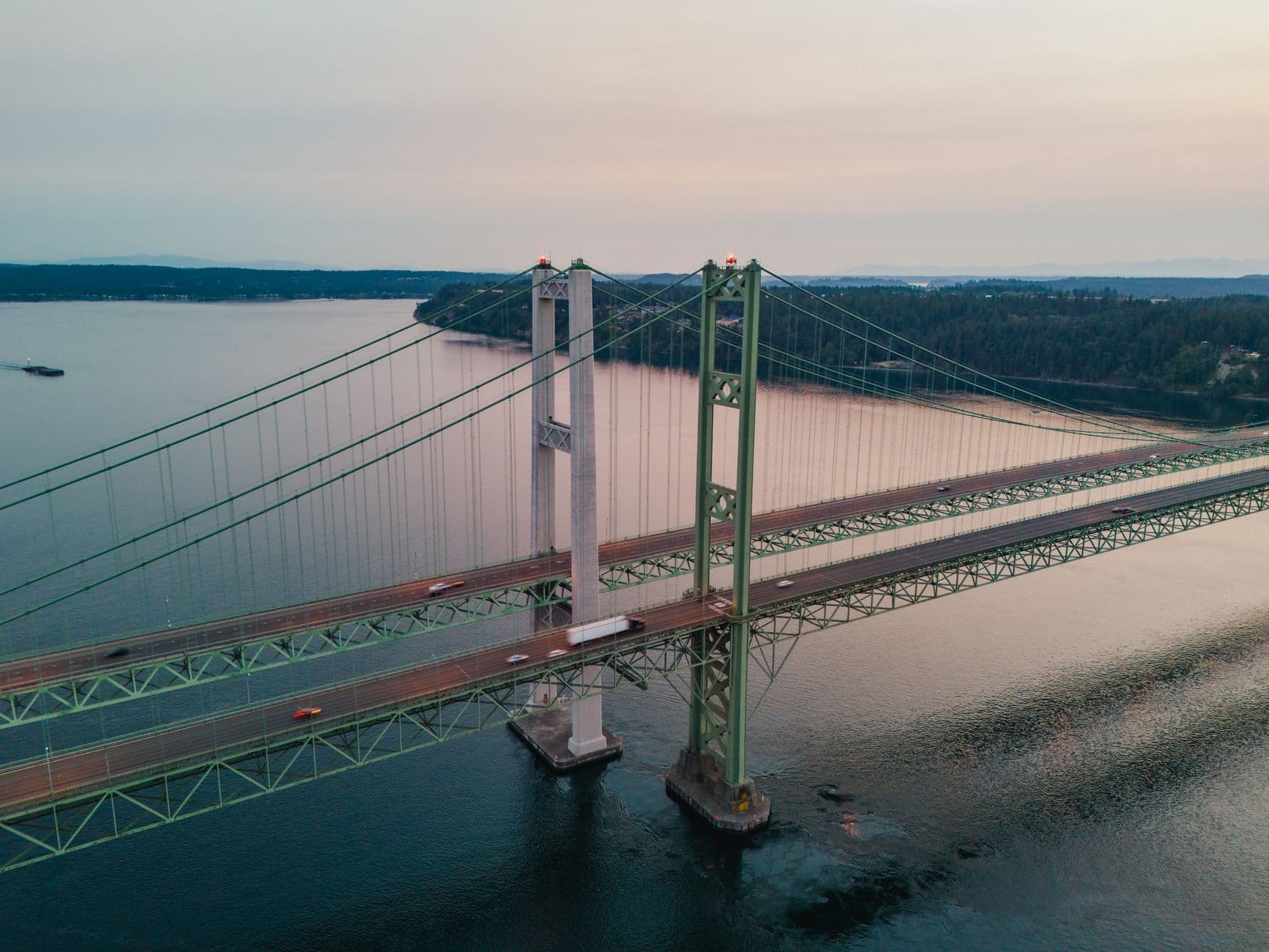

The longest bridge in the world is the Danyang-Kunshan Grand Bridge in Jiangsu, China, at 164.8 kilometres. No truck will ever cross it. It is a viaduct carrying the Beijing-Shanghai high-speed railway, a passenger line, and the second entry on the list is another high-speed viaduct in Taiwan at 157.3 kilometres.
That gap between the headline ranking and anything a dispatcher can use runs through the whole table. In twenty years of routing I have never picked a crossing because of a bridge's length. I have rerouted plenty of loads because of a posted axle limit, a height gantry, or a queue at the border post sitting on the far abutment. Length is the record. Load rating, clearance and the customs plaza at the end are the freight story.
The longest bridges in the world, ranked
| # | Bridge | Country | Length | Carries | Freight relevance |
|---|---|---|---|---|---|
| 1 | Danyang-Kunshan Grand Bridge | China | 164.8 km | High-speed rail | None for road or rail freight |
| 2 | Changhua-Kaohsiung Viaduct | Taiwan | 157.3 km | High-speed rail | None |
| 3 | Tianjin Grand Bridge | China | 113.7 km | High-speed rail | None |
| 4 | Cangde Grand Bridge | China | 105.8 km | High-speed rail | None |
| 5 | Weinan Weihe Grand Bridge | China | 79.7 km | High-speed rail | None |
| 6 | Hong Kong-Zhuhai-Macao Bridge | China | 55 km | Road | Cross-boundary trucks under a permit quota |
| 7 | Sheikh Jaber Al-Ahmad Al-Sabah Causeway | Kuwait | 48.5 km total, 36 km main link | Road | Kuwait City to Subiya, domestic haulage |
| 8 | Lake Pontchartrain Causeway | United States | 38.4 km | Road | Local trucking north of New Orleans |
| 9 | King Fahd Causeway | Saudi Arabia to Bahrain | 25 km | Road | The Gulf's busiest land border by vehicles |
| 10 | Øresund fixed link | Denmark to Sweden | 16 km link, 7.8 km bridge | Road and rail | 706,411 freight vehicle crossings in 2025 |
Five of the top six are Chinese or Taiwanese rail viaducts. That is not an accident of geography. A viaduct on a high-speed alignment exists to hold the track geometry flat and straight across soft ground and farmland, not to cross water, and once you build on piers for that reason the kilometres accumulate quickly. Nothing about the structure implies a freight path.
The crossings that show up in a routing plan
The Hong Kong-Zhuhai-Macao Bridge is the longest structure in the world that a container truck can legally use, at 55 kilometres including its undersea section. Traffic has grown fast from a slow start: more than 1.91 million cargo trucks passed through the Zhuhai port of the bridge in its first five years, and in the first four months of 2024 alone 184,900 cargo trucks crossed, up more than 21 percent year on year. Growth has not levelled off since. Single-permit Hong Kong and Macao vehicles alone made over 1.03 million crossings in the first quarter of 2026, a quarterly record and 17 percent up on the year.
The Øresund link is the one I quote most often when someone assumes a bridge is just a road. Its 2025 annual report counts 706,411 crossings by trucks and vans over six metres, and within that, 605,900 crossings by vehicles over nine metres, which beat the previous heavy-vehicle record of 597,559 set in 2022. The nine metre subset averaged 1,668 crossings a day and grew 3.4 percent on the year. Pick the wrong category and your year-on-year comparison moves by a hundred thousand vehicles, which is the same measurement trap that runs through every ranking on this page. Rail runs underneath the same deck structure, so Scandinavian intermodal planning treats the link as one asset with two capacities rather than as a motorway.
King Fahd Causeway is only 25 kilometres, ninth on this list and nowhere near a record, yet it is reported to carry roughly 45,000 vehicles a day and up to 60,000 at weekends, and it logged more than 33 million passengers in 2024. For anyone moving goods between Saudi Arabia and Bahrain it is the crossing. Its constraint has never been the deck: congestion there is routine and usually traces to a systems outage or a peak-hour surge at the inspection lanes rather than to any shortage of road. That is the same pattern I described in our ranking of the world's busiest border crossings.
Span is the real engineering record
Total length rewards flat ground and long viaducts. The harder number is the main span, the distance between towers with nothing underneath, because that is what decides whether a strait can be bridged at all.
- 1915 Çanakkale Bridge, Türkiye: a 2,023 metre main span, the longest suspension span in service, opened 18 March 2022 with side spans of 770 metres and a total length of 3,563 metres, forming part of the 101 kilometre Malkara to Çanakkale motorway.
- Strait of Messina Bridge, Italy: designed for a 3,300 metre span with 399 metre towers and a budget of 13.5 billion euros. It is also the least certain entry here. The audit court rejected registration of the project approval in June 2026 and prosecutors in Rome opened a corruption investigation, so no foundation work has started. Ministers have talked about opening in 2032 or 2033, while the project company puts construction at seven and a half years, which from a fourth-quarter 2026 start means completion in 2033 and service in 2034.
- Huajiang Grand Canyon Bridge, China: opened 28 September 2025 with a deck around 625 metres above the Beipan river and a main span of 1,420 metres, cutting a mountain journey that used to take hours down to about two minutes.
Messina matters commercially in a way the others do not. Sicily currently depends on train ferries and RoRo shuttles across the strait, and rail wagons are shunted onto vessels before continuing. A fixed link would remove that break for the first time since the service began. It would also remove the business case for the ferry operators who run it, which is part of why the project has taken half a century without reaching a single pier. If you are planning Sicilian freight for the next five years, plan around the ferry.
What actually stops a truck is a plate, not a kilometre

Weight limits are where bridge rankings meet reality. The standard maximum for a heavy goods vehicle across the European Union is 40 tonnes, rising to 44 tonnes for intermodal journeys, and every structure on the route has to accept that. Where it does not, the posting is brutal in its simplicity.
San Juanico Bridge in the Philippines, the country's longest at 2.16 kilometres, is the case I point people to when they assume a restriction eases over time. Traffic returned in both directions in December 2025 under a 15 tonne cap. By June 2026 the limit had tightened rather than lifted, to an axle load of three tonnes, which removes heavy goods vehicles from the crossing altogether. The published target is a return to 33 tonnes in both directions by October 2026. Eastern Visayas shippers have spent the intervening period routing through alternative access points, and anyone who planned on the December figure was wrong by June.
Bridges are usually more permissive than tunnels for dangerous goods, since ventilation and evacuation are not constraints in open air, so a class of cargo barred from an Alpine bore will often be waved across a viaduct. That asymmetry is worth knowing when a hazardous load has to cross a mountain range, and we covered the tunnel side of it in detail in our tunnel ranking.
The other lesson of the last two years is that a bridge can be a maritime chokepoint rather than a road one. When the Francis Scott Key Bridge collapsed at Baltimore on 26 March 2024 after the container ship Dali lost power, the damage to trucking was secondary. The port behind it was closed to deep-sea traffic, car carriers and bulk vessels were diverted to Norfolk and New York, and the replacement structure is currently financed for a 2030 opening. A vessel owner and operator settled with the United States for more than 100 million dollars over the destruction. If you have a bridge over your terminal approach, it belongs in your risk register alongside the berth.
Where this sits with our other infrastructure rankings
Read this next to our ranking of the longest tunnels in the world, because the two structures fail in opposite ways: tunnels restrict what you may carry, bridges restrict how much it may weigh. Pair it with the longest highways and with countries with the largest road networks if you are assessing a corridor rather than a single structure, and with the busiest border crossings when the bridge doubles as a frontier, as King Fahd and Hong Kong-Zhuhai-Macao both do.
Frequently asked questions
What is the longest bridge in the world in 2026?
The Danyang-Kunshan Grand Bridge in China at 164.8 kilometres, carrying the Beijing-Shanghai high-speed railway. It has been the record holder since 2011 and no structure has passed it, because record attempts have moved towards span, height and difficult terrain rather than total length.
What is the longest bridge a truck can drive across?
The Hong Kong-Zhuhai-Macao Bridge at 55 kilometres, though cross-boundary goods vehicles need a permit and the quota schemes have been widened in stages. The Sheikh Jaber Al-Ahmad Al-Sabah Causeway in Kuwait is longer as a maritime crossing at 48.5 kilometres combined, but it serves domestic traffic rather than an international corridor.
Which bridge has the longest span?
The 1915 Çanakkale Bridge in Türkiye at 2,023 metres between towers. The Strait of Messina Bridge is designed at 3,300 metres and would take the record, but the audit court rejected registration of its approval in June 2026 and a corruption investigation is open, so construction has not begun. Even on the project company's own figure of seven and a half years of building, service would not start before 2034.
How much weight can a bridge take?
It depends on the individual structure and its assessment, not on any global rule. The European Union standard limit for a heavy goods vehicle is 40 tonnes and 44 tonnes for intermodal work, but a posted bridge can sit far below that, and the posting can move against you. San Juanico Bridge reopened two-way at 15 tonnes in December 2025 and was tightened to a three tonne axle load by June 2026, which bars heavy goods vehicles outright until the planned return to 33 tonnes.
Do bridges restrict dangerous goods the way tunnels do?
Rarely to the same degree. Tunnel restriction codes exist because of ventilation and evacuation risk in a confined bore, and an open deck does not carry that exposure, so hazardous cargo generally has more options on bridges. Local prohibitions still exist on urban and estuarial crossings, so check the specific structure before dispatch.
Bridge lengths follow the figures published by the owners and builders; totals for causeways vary depending on whether approach viaducts and artificial islands are counted, which is why the Øresund link appears here both as a 16 kilometre crossing and a 7.8 kilometre bridge. Traffic counts come from the operators and, for Hong Kong-Zhuhai-Macao, from mainland port authority releases. Construction dates for Messina reflect the current approved programme and have moved before. Weight limits, permit quotas and posted restrictions change without much warning: confirm the load rating, the clearance and the permit position for your specific route before you commit a vehicle to it.